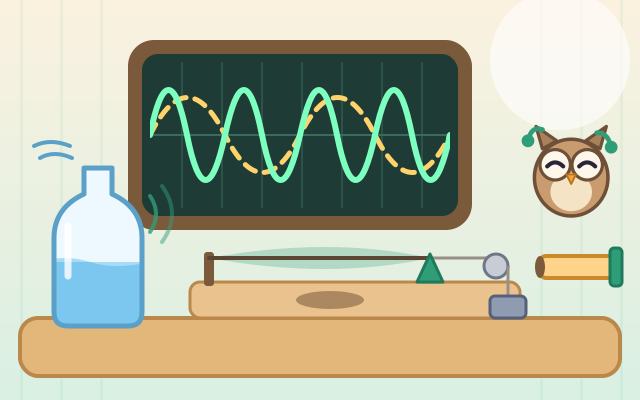
A hands-on game about the physics of sound. Dr. Owl's lab takes orders from animal friends: tune a string to 400 Hz, make a pipe sound the same as a bottle, work out how far away the lightning was… Every sound is drawn on an oscilloscope: closer waves mean a higher frequency and a higher note, taller waves mean a louder sound, and every trace is labelled with its frequency, so pitch is compared by sight as well as by ear. The target is a dashed line and your sound a solid one, so no one needs to tell colours apart.
Six chapters, 24 levels: (1) Vibration and sound: gentle and hard plucks, a pressed string, a bell in a jar with the air pumped out, and counting waves on the screen to find the Hz. (2) String length: pressing the string at a different mark changes the vibrating length; half the length, twice the frequency. (3) Thickness and tension: thicker strings and hanging weights; 4 times the pull only doubles the frequency. (4) Bottles: blowing, more water gives a higher note; tapping, more water gives a lower note, the opposite way. (5) Pipes: closed and open pipes; half the length, twice the frequency; an open pipe is twice as high as a closed one, and a bottle with water is really a closed pipe. (6) How sound travels: a race through air, water and steel, hearing a tap twice with an ear on a rail, counting seconds after lightning, measuring the sea with sonar, and why space is silent.
There are two kinds of level. Tuning jobs ask you to change the physical settings of an instrument, and fewer tests earn more stars. Predict-then-test levels ask you to choose an answer before the experiment reveals it and explains why. Random jobs for strings, bottles and pipes are generated, so there is always another one. Every frequency comes from real formulas, such as f = (1/2L)√(T/μ) for a string and f = speed of sound ÷ 4L for a closed pipe.
How to play
- Press Start, or open Levels and pick a chapter; clearing 2 levels opens the next chapter. The first time you enter a chapter, a Lab note explains its key idea; you can read all notes again from Lab notes on the title screen.
- Tuning jobs: the card at the top gives the target frequency, and the dashed wave on the oscilloscope is the target. Tap marks to change the settings (only the ones this level lets you change are shown), then press Pluck, Tap or Blow. The oscilloscope draws your sound (solid line) with its frequency and says whether it is higher or lower than the target. Match it to finish: within 2 tests earns 3 stars, within 4 earns 2, more earns 1, and you always finish.
- Predict-then-test: each level has 3 questions. Tap the answer you believe, then watch the waves and frequencies of A (dashed) and B (solid), or the race of sound through different materials. All correct earns 3 stars, one wrong earns 2.
- With every weight removed, the string is slack: plucking it makes no note and the oscilloscope shows a flat line, so hang a weight again.
- Stuck? Press the light bulb. The first hint tells you how many times the target is compared with now and the rules that apply (half the length, twice the frequency), and later hints suggest exactly which setting to change, but then the most you can earn is 2 stars.
Controls
- Phone / tablet: in tuning levels, tap the mark buttons below (or the marks on the instrument itself) to change the string length, thickness, weights, water level, pipe length or pipe end, then press Pluck / Tap / Blow to test. You can also tap the string, bottle or pipe directly to make it sound.
- In prediction levels, tap an answer card first, then watch the oscilloscope or the sound race reveal the result; press Next to go on. After the experiment, tap instrument A or B to hear it again.
- The light bulb at the top right is a hint: the first press tells you how many times higher or lower the target is and the rules that apply, the next press suggests one setting to change. The speaker turns sound on or off.
- Keyboard: ↑ ↓ change row, ← → pick a mark, Enter hang or remove a weight, Space make the sound, 1–3 answer, Enter next question or level, H hint, M sound, Esc back.
For parents
- Designed for ages 9–12, and fun for teens and adults too: the core ideas of a school unit on sound and waves. It covers sound as vibration, amplitude and loudness, frequency and pitch (what Hz means and reading it from a wave), how string length, thickness and tension change the frequency (inverse and square-root relationships), why tapping and blowing a water bottle change in opposite ways (a different thing is vibrating), resonance in closed and open pipes, sound needing a medium (no sound in a vacuum), the speed of sound in air, water and steel, and using it to estimate the distance of lightning and the depth of the sea.
- The game makes pitch visible on purpose: every sound has both an oscilloscope trace and a frequency number, and the target and your own sound are told apart by dashed and solid lines, so no musical ear or good hearing is needed. There is no sheet music, no scales and no performing; the point is changing physical conditions and watching cause and effect. The tapped-bottle pitch uses a simplified model of the "more water, lower note" trend; every other frequency comes from the physics formulas.
- No timer: tuning levels can always be finished and the number of tests only changes the stars, and a wrong prediction is explained before moving on. No chat, in-app purchases, ads or outbound links, and nothing to type in. Stars, notes already seen, the random-job count and the sound setting are stored only in this device's browser; all sounds are synthesised live and can be muted at any time.