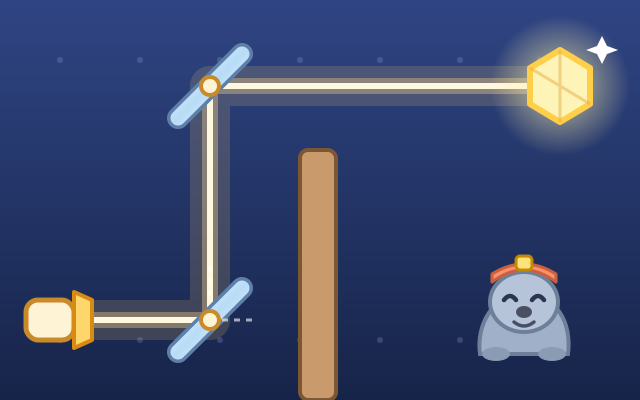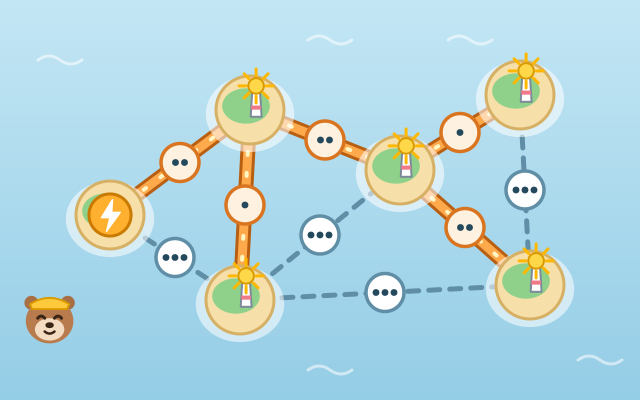
A puzzle game about graphs and network algorithms. On procedurally generated islands, dashed lines show the undersea cables you could lay, each with a cost. Tap a cable to lay it, and every island joined to the power-plant island lights its lighthouse straight away; press "Power on!" and current flows along your cables. The goal is to power every island for the lowest total cost, which computer scientists call a minimum spanning tree.
When your cables close a loop, white dots march along it to show that one of them is spare. The task bar shows the current cost, the 3-star mark, the cable count (N islands need at least N − 1) and how many islands are lit. The 3-star mark is the lowest cost, worked out with Kruskal's algorithm.
There are 5 chapters and 30 levels: Power Everyone (spanning trees and loops), Cheapest First (Kruskal's algorithm, with several answers when costs tie), Old Cables (free cables that are already laid, with the cut property and Prim's algorithm), Cheapest Route (power for one target island only: the shortest path, where fewer cables isn't always cheaper and the path in a minimum spanning tree isn't always shortest) and Dijkstra by Hand: each island shows a tentative distance, you tap the island that can be fixed next, and watch its neighbours' numbers drop (relaxing) until you have the shortest-path tree. Random islands give endless extra maps.
How to play
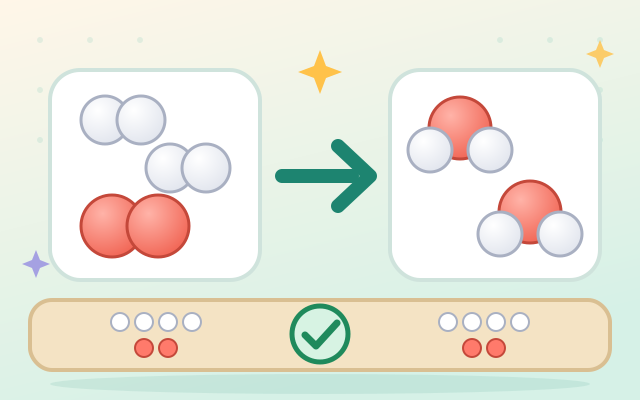
- Tap "Start laying" to carry on from the first level you haven't cleared, or pick a chapter from "Levels". The first time you open a chapter, an engineer note explains its algorithm with a small picture, and "Engineer notes" on the title screen lets you read them again.
- Chapters 1–3: tap dashed cables to lay them so every island is joined to the power plant with the lightning bolt (a lit lighthouse means it is joined), then press "Power on!". If an island is still cut off, it wobbles, and nothing is lost. In Chapter 4 only the flagged target island needs power, and every cable you lay costs money.
- Chapter 5: the box above each island is its tentative distance (a dashed box, or "?" if unknown); once fixed it becomes a solid box with a tick. Tap the unfixed island with the smallest number. A wrong tap explains why that island can't be fixed yet and counts as one miss.
- Matching the lowest cost earns 3 stars, a little more (up to 2 or 15% over) earns 2, and anything more still clears the level with 1. In Chapter 5, no misses earns 3 stars and 1–2 misses earn 2. A hint caps the level at 2 stars. Clearing 3 levels of a chapter opens the next one.
Controls
- Phone / tablet: tap a dashed cable between two islands (on the line or its cost circle) to lay it, and it turns solid orange; tap it again to remove it. Grey cables with a padlock are old ones and stay. The buttons below are Undo, Remove all and "Power on!" to check. In Chapter 5 you tap islands instead, and the bottom-left button restarts the level. The light bulb at the top right gives a hint.
- Mouse: the same as touch: click a cable to lay or remove it, and click islands in Chapter 5.
- Keyboard: ← → choose a cable (an island in Chapter 5), Enter or Space lays or removes it (fixes the island in Chapter 5); P power on, U or Backspace undo, R remove all or restart, H hint, M mute, Esc cancels the choice or goes back.
For parents
- Made mainly for teens, and 9–12-year-olds can start with Chapter 1. It covers graph theory from computing and discrete maths: nodes and edges, weighted graphs, trees and cycles (a tree on N nodes has exactly N − 1 edges), Kruskal's and Prim's algorithms for minimum spanning trees, the cut property, why a greedy method is guaranteed to work here, shortest paths and Dijkstra's algorithm (tentative distances, relaxing, the shortest-path tree), and the fact that a minimum spanning tree and a shortest path are different problems.
- A good conversation starter: how power, water and internet companies plan their lines, how a map app finds a route, and how data packets choose their way across the internet. There is no timer. An island that isn't joined just wobbles and a wrong tap is explained, without ending the level, and Undo and Restart are always there. Islands are told apart by letters and symbols (bolt, flag, lit or dark lighthouse), laid and unlaid cables by solid and dashed lines, and tentative and fixed distances by dashed boxes and ticks, so nothing depends on color.
- No chat, in-app purchases, ads, outbound links or online leaderboards, and no personal details are ever asked for. Stars, seen notes, the number of random maps solved and the mute setting are stored only in this device's browser, and the game also works offline.