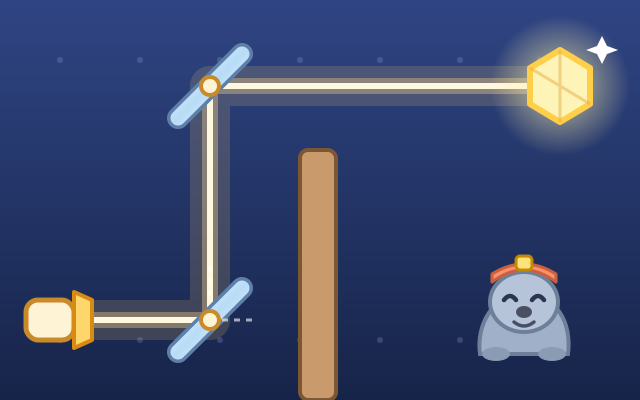
A hands-on game about reflection in plane mirrors. Seal the lighthouse keeper's optics table has lamps, mirrors, blocks and light-sensing crystals, and the beam's path is worked out live with the real law of reflection: where it meets a mirror the normal is drawn and the angle of incidence i and angle of reflection r are labelled, so turning the mirror shows that the two are always equal. The beam is a soft, warm band of light with nothing about shooting or weapons.
Five chapters of four levels: (1) The law of reflection: turn one mirror to light a crystal, and answer "to move the beam to the other crystal, how far must the mirror turn?" (the beam turns twice as far). (2) Several mirrors: pass the beam along two or three mirrors around blocks, with one spare mirror to ignore. (3) Periscopes and corner reflectors: see over a wall with two 45° mirrors, then set two mirrors at 90° so three beams from different directions all go straight back. (4) Images in a mirror: put a marker on the duckling's image, and turn a mirror so an eye can see a duckling on the other side of a wall. (5) Two-mirror images: open a pair of hinged mirrors until exactly 3, 5, 7 or 11 images appear.
The first time you enter a chapter, an illustrated Lab note explains the idea. Random challenges in four kinds (guide the light, how many degrees, find the image, count images) are generated and checked with a solver to have an answer, so there is always another one.
How to play
- Press Start, or open Levels and pick a chapter; clearing 3 levels opens the next chapter. The card at the top shows the goal, and goals get a tick as you reach them.
- Turn the mirrors and follow the beam: where it meets a mirror, the angle of incidence equals the angle of reflection. A crystal lights up with a tick when the beam reaches it; the beam passes through crystals, so one beam can light several. When every goal is met and you let go, the level is clear.
- In "how many degrees" levels, think before you answer: turn the mirror x° and the reflected beam turns 2x°. In image levels, drag the dashed duckling behind the mirror and press Check!; a wrong answer tells you how far the duckling and your marker are from the mirror. In counting levels, turn mirror B to change the angle and every image is drawn live.
- No hints and no wrong answers earns 3 stars; each hint or wrong answer takes one away, down to 1, and you always finish the level. Stuck? The light bulb explains the idea and draws the target angle.
Controls
- Phone / tablet: press on the ring around a mirror (or its yellow handle) and drag around it to turn the mirror in 1° steps; mirrors on a hinge are turned by dragging the glass itself. Or use ↺ ↻ (1°) and ↺5 ↻5 below; hold a button to keep turning. With several mirrors, first tap Mirror 1, Mirror 2 or Mirror A, Mirror B to pick the one to turn.
- Image levels: drag the dashed duckling to where you think the image appears (or just tap that spot), then press Check!. In "how many degrees" levels, tap an answer card.
- The light bulb at the top right is a hint that says which mirror to turn, which way and about how far, and draws the target angle faintly; the speaker turns sound on or off.
- Keyboard: Tab or 1–4 pick a mirror, ← → turn 1° (hold Shift for 5°), arrow keys move the image marker (Shift for 5 steps), 1–4 pick an answer card, Enter check (Next once done), H hint, R reset, M sound, Esc back.
For parents
- Designed for ages 9–12 and best for early teens, fun for adults too: the reflection topic of middle-school physics. It covers the normal, the angles of incidence and reflection, the law of reflection, why turning a mirror by θ turns the reflected beam by 2θ, light paths through several mirrors, periscopes (two parallel 45° mirrors), right-angle corner reflectors (light returns parallel, as in bike reflectors and the reflectors on the Moon), images in a plane mirror (virtual, as far behind the mirror as the object is in front, on a line at right angles to it, flipped left to right, and the path light takes from the object to the eye), and the 360 ÷ θ − 1 images formed by two mirrors at angle θ (the kaleidoscope).
- Light paths, image positions and image counts are computed from real geometry rather than pre-drawn animation, so children can freely try "what if I turn it a bit more?". In the counting levels each image is worked out from the repeated reflections between the two mirrors, so angles that do not divide 360° show their true, uneven count and layout, which helps explain why the formula only works when the angle divides evenly.
- No timer and no failure: every level can always be finished, and hints and wrong answers only change the stars; hints are unlimited. The beam is a soft band of light, with no violence or competition. Nothing depends on telling colours apart (several beams are solid, dashed and dotted with ● ▲ ■ marks, and mirrors carry shape marks). No chat, in-app purchases, ads or outbound links, and nothing to type in. Stars, notes already seen, the random-challenge count and the sound setting are stored only in this device's browser; sound can be turned off.