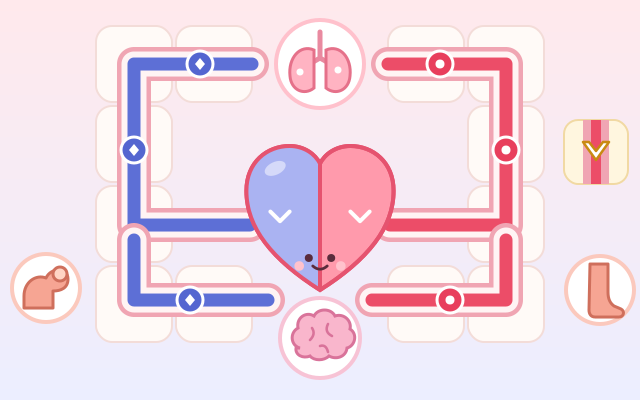
A rotating-tile puzzle about how blood circulation and breathing work. The grid holds a friendly heart with its four chambers (right atrium, right ventricle, left atrium, left ventricle), lungs, and organs such as the brain, stomach, kidneys, intestines and arm and leg muscles, with straight pipes, bends, T-branches and one-way valves scattered in between. Tap a tile to turn it 90° and build the lung loop (right ventricle → lungs → left atrium) and the body loop (left ventricle → organs → right atrium). Pipes joined to the heart or an organ change colour at once: oxygen-rich blood is red with a ● mark, carbon-dioxide-rich blood is blue-purple with a ◆ mark, so colour is never the only cue.
Press Beat! to test: the heart goes lub-dub, red blood cells flow along the pipes, swap carbon dioxide for oxygen in the lungs (O₂ in, CO₂ out) and leave oxygen at the organs. If an opening points at nothing, the two kinds of blood mix, or a valve faces the wrong way, the game marks the spot and explains why, and you simply fix it and try again.
Five chapters, 25 levels: (1) the lung loop; (2) the body loop, then both loops together; (3) heart valves, whose arrows must follow the flow; (4) branches: two lungs and several organs; (5) the body at exercise: the heart rate rises from 75 to 140 beats a minute, breathing speeds up, and the leg vein has a valve too. On a flat board the two loops must cross, just as the real pulmonary artery crosses the aorta, so the grid has fixed overpass tiles. Every level is generated and guaranteed solvable, Random practice never runs out, and each finished level ends with a short circulation fact.
How to play
- Press Start piping, or open Levels and pick a chapter; clearing 2 levels opens the next chapter. The first time you enter a chapter a Loop note explains it; you can read all notes again from Loop notes on the title screen.
- The card at the top says which loop to build. Tap tiles until the openings line up: the right ventricle's exit must reach the lungs and the lungs must return to the left atrium; the left ventricle's exit must reach every organ and every organ must return to the right atrium. Grey pipes with bolts are already connected and can't turn, and the lavender overpass tiles, where two vessels pass over each other, can't turn either. Spare pipes don't have to be used, but once one joins a vessel, its openings must be connected too.
- Then press Beat!. If it works, the blood flows all the way round and the level is done. If not, an orange "!" marks an opening that points at nothing or an entrance that isn't reached, a dashed frame marks where the two kinds of blood mix, and an orange frame marks a backwards valve. Fix it and press again; there is no timer.
- The V-shaped arrow on a valve tile shows the way blood may flow and must follow the flow: valves leaving a ventricle point away from the heart, and the vein valve on the way back from the leg points towards the heart.
- Stars: success on the first test earns 3; 1–2 failed tests or using a hint earns 2; more earns 1, and you always finish. The light bulb hint turns one pipe to the right position for you.
Controls
- Phone / tablet: tap a blood-vessel tile to turn it 90° clockwise and line up the openings, then press Beat! to test. Tap the heart, a lung or an organ to hear what it does.
- Buttons below: Undo takes back the last turn and Restart returns the level to how it began; the light bulb at the top right is a hint and the speaker turns sound on or off.
- Mouse: left click turns clockwise, right click turns anticlockwise.
- Keyboard: arrows move the frame, Enter / Space turn, Q (or Shift+Enter) turn back, B heartbeat test, U undo, R restart, H hint, M sound, Esc back; after a level, Enter goes to the next one.
For parents
- Designed for ages 9–12, and fun for teens and adults too: from upper-primary science on circulation and breathing to lower-secondary biology on the circulatory system and gas exchange. It covers the four chambers of the heart and where they sit (atria on top collect blood, ventricles below push it out; left and right swap when you face someone), the routes of the lung loop and the body loop, arteries and veins named for leaving or returning to the heart (the pulmonary artery carries oxygen-poor blood and the pulmonary vein oxygen-rich blood), oxygen and carbon dioxide exchange between air sacs and capillaries, the four valves that stop backflow and make the heart sounds, the aorta branching to the organs, two lungs, leg vein valves, and why the heart and breathing speed up during exercise.
- The pictures are deliberately simple and friendly: the heart has a face and the organs are cartoon icons, with no anatomical drawings, wounds or drops of blood. Oxygen-rich and oxygen-poor blood differ by colour and also by ● and ◆ marks, so children with colour-vision differences can play. Because the two loops must cross on a flat grid, fixed overpass tiles show vessels passing over each other. Heart and breathing rates are typical reference values (about 75 beats and 18 breaths a minute at rest, about 140 and 40 during exercise).
- No timer: a failed test only marks the problems and explains them, every level can be finished, and failed tests only change the stars. No chat, in-app purchases, ads or outbound links, and nothing to type in. Stars, notes already seen, the random-practice count and the sound setting are stored only in this device's browser; all sounds are synthesised live and can be muted at any time.