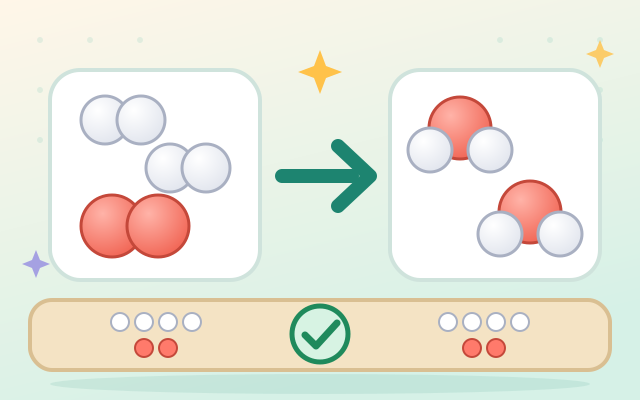
A hands-on game for practising how to balance chemical equations. Every level is a real reaction, with reactants and products drawn as 3D space-filling models in which each kind of atom always has the same element symbol, colour and size. You can only change the coefficient in front of each substance (how many molecules there are), and the atom count below tallies every kind of atom on each side as you go, marking matched ones with a tick and the rest with a not-equal sign.
Five chapters, 30 levels: (1) Counting atoms: hydrogen chloride, water, magnesium oxide, table salt, ammonia, splitting water. (2) Burning: carbon monoxide, methane, alcohol, propane, ethane. (3) Everyday and nature: photosynthesis, respiration, rusting, hydrogen peroxide breaking down, heating baking soda and copper. (4) Metals, acids and ores: aluminium oxide, the blast furnace, aluminium in acid, neutralisation, marble in acid, iron chloride. (5) Master balancer: oxygen from potassium chlorate, oxidising ammonia, acetylene, butane, pyrite, and finally octane (petrol) at 2 : 25 : 16 : 18.
A level is done when every atom matches and the coefficients are the simplest whole numbers: 4 : 2 : 4 balances too, but the game reminds you it can be reduced. When you finish, the reactant molecules break into single atoms that fly across and build the products, so children can see that no atom appears or disappears. Random practice mixes the level reactions with 18 fuels (alkanes, alkenes, alkynes and alcohols) burning, so there is always another one.
How to play
- Press Start balancing to jump to the first level you haven't cleared, or open Levels and pick a chapter; clearing 3 levels opens the next one. The first time you enter a chapter, a Lab note with molecule pictures explains its key idea; all notes can be read again from Lab notes on the title screen.
- Reactants are on top and products below. Press + or − under a substance to change the big number in front (the coefficient), and the molecule picture stacks up. Watch the atom count: the left column is the atoms before the reaction and the right column after. When every row has a tick and the coefficients can't all be divided by the same number, the equation is balanced.
- Tip: start with atoms that appear in only a few substances and leave single-element substances like O₂ for last. If oxygen always comes out one short, double every coefficient.
- Stuck? The light bulb first tells you which atom to look at, and each further press fills in one coefficient. No hints earns 3 stars, one hint 2 and more than that 1; you can always finish, and Reset all lets you start the equation over.
Controls
- Phone / tablet: tap − / + under each substance to change its coefficient, and hold to keep counting. Tap a molecule picture to see which atoms it is made of and why its subscripts can't change.
- The light bulb at the top right is a hint: the first press points out which atom is still off and where to start, and each later press fills in one coefficient for you. The speaker turns sound on or off, and the circular arrow beside the message resets everything.
- Once balanced, an animation shows the atoms regrouping; tap it to skip to the result card.
- Keyboard: ← → pick a substance, ↑ ↓ (or + −) change its coefficient, R reset, H hint, I about the substance, M sound, Enter next, Esc back.
For parents
- Designed for ages 9–12 and best for early teens, fun for adults too: the "chemical reactions and conservation of mass" topic of middle-school science. It covers atoms and molecules, what a chemical formula means, the difference between coefficients and subscripts (changing a subscript makes a different substance), groups in brackets, why the kinds and numbers of atoms stay the same in a reaction (conservation of mass), simplest whole-number ratios, and common reactions: burning, photosynthesis, respiration, rusting, decomposition, neutralisation and metals in acid.
- Every answer is worked out and checked by the program with linear algebra rather than typed in, and hints follow the child's own numbers (if they have already doubled everything, the hint helps along that doubled path). The finishing animation moves every actual atom from the reactants to its place in the products, so "atoms only regroup" becomes something you can see.
- No timer and no failure: every level can always be finished, and hints only change the stars. The content is chemical equations only; where carbon monoxide comes up it notes that burning charcoal needs fresh air. There is no violence, no instructions for risky experiments and no competition. Every atom shows its element symbol, so nothing depends on telling colours apart. No chat, in-app purchases, ads or outbound links, and nothing to type in. Stars, notes already seen, the random-practice count and the sound setting are stored only in this device's browser; sound can be turned off.