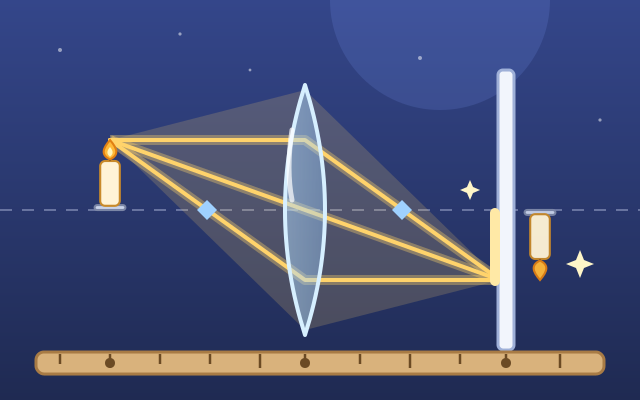
A hands-on game about geometric optics. Penguin the optician's workbench has a 100 cm optical rail, and animal customers bring requests: project the candle onto the screen, make the image twice as big, build a 3× magnifier, see a faraway hot-air balloon clearly. The light is worked out live with the real thin-lens formula (1/f = 1/u + 1/v): a beam from the flame passes through the lens, three key rays (parallel, through the centre, through the focal point) mark where the image forms, and the image blurs when the screen is in the wrong place.
Five chapters of four levels: (1) Projecting: move the screen, the candle or the lens until the image is sharp. (2) Image size: make images the same size, twice as big and half as big, and pick the one lens out of three with the right focal length. (3) Magnifiers and concave lenses: with no screen, look into the lens from the right to make an upright, enlarged virtual image, and find out that a concave lens always gives a smaller upright one. (4) Mystery lenses: focus sunlight, make a same-size image, or measure object and image distance to work out an unknown focal length. (5) Two lenses: build a Keplerian telescope, choose an eyepiece for the right magnification, project an upright image with two convex lenses, and make a Galilean telescope with a concave eyepiece.
A small window shows what the screen or the eye sees (upright or upside down, how many times, sharp or blurry), and the rail always marks the distances between parts. Random challenges in all five kinds are generated and checked to have an answer, so there is always another one.
How to play
- Press Start, or open Levels and pick a chapter; clearing 3 levels opens the next chapter. The first time you enter a chapter, a Lab note with a diagram explains its key idea; all notes can be read again from Lab notes on the title screen.
- The card at the top lists the rules of the order. Drag parts along the rail and watch the light: the image is sharpest when the rays meet on the screen, and the small window says whether the image is upright or upside down and how many times bigger. Press Check! when ready: rules that fit get a tick, the rest a cross with the reason. All correct on the first check earns 3 stars, on the second 2, after that 1; you always finish the level.
- Magnifier and telescope levels have no screen: there is an eye on the right and the small window shows what it sees. A telescope must send the light out parallel for the balloon to look sharp.
- Mystery-lens levels hide the focal points and the focal length. Experiment and measure first, then tap an answer card; a wrong guess is not a failure, the card is crossed out and you can measure again.
- Stuck? The light bulb explains the idea behind this kind of puzzle and tells you which part to move, which way and roughly how far, or which lens to swap in. Random lets you pick a kind of puzzle and play without end.
Controls
- Phone / tablet: drag the candle, a lens or the screen left and right on the dark bench (touch near the part or its round knob under the rail); positions snap to whole centimetres. Or tap a part button below and press ◀ ▶ (1 cm) or −5 / +5; hold a button to keep moving.
- In levels with lens cards, tap a card to swap in a convex or concave lens with another focal length. In mystery-lens levels, experiment first and then tap the answer card with the focal length. Everywhere else, press Check! when your setup is ready.
- The light bulb at the top right is a hint that says which part to move, which way and roughly how far; the speaker turns sound on or off.
- Keyboard: ↑ ↓ pick a part, ← → move 1 cm (hold Shift for 5 cm), C swap lens, 1–4 pick a focal-length answer, Enter check (Next once done), H hint, M sound, Esc back.
For parents
- Designed for ages 9–12 and best for early teens, fun for adults too: the lenses topic of middle-school physics. It covers converging convex and diverging concave lenses, focal points and focal length, the three standard ray-diagram rays, real images (upside down, can be caught on a screen) and virtual images (upright, seen only by the eye), how the image's position and size depend on where the object is (at 2f, between f and 2f, inside f), magnification = image distance ÷ object distance, the thin-lens formula 1/f = 1/u + 1/v, three ways to measure a focal length, and two-lens systems (Keplerian and Galilean telescopes, magnification = f₁ ÷ f₂, and how two flips make an upright image).
- Rays and images are computed with real paraxial optics rather than pre-drawn animation, so children can freely try "what if the candle comes a little closer?" and match what they see against the formula. The vertical direction is stretched so things are easy to see, but every crossing point and ratio is correct. Mystery-lens levels hide the focal length on purpose to reward measuring and calculating over guessing.
- No timer and no failure: every level can always be finished, and the number of checks or wrong guesses only changes the stars; hints are unlimited. The content is purely optics experiments, with no violence or competition. Nothing depends on telling colours apart (parts and lenses have distinct shapes). No chat, in-app purchases, ads or outbound links, and nothing to type in. Stars, notes already seen, the random-challenge count and the sound setting are stored only in this device's browser; sound can be turned off.