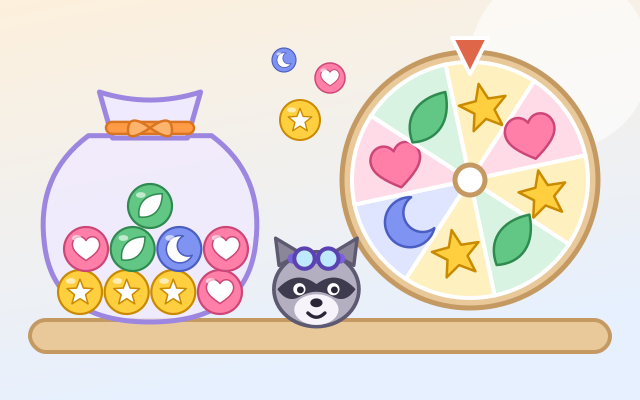
A hands-on game about probability. Raccoon the inventor takes orders from animal friends: two brothers want a fair way to pick who goes down the slide first, three friends need to choose who tells the first story, and the science class wants to predict before experimenting. Every ball and spinner slice carries its own shape (star, heart, leaf, moon), so no one needs to tell colours apart.
Five chapters of five levels: (1) Bags of balls: use + / − to set how many of each ball, so that "the chance of a star is 1/3", "a heart is more likely than a leaf", "a moon is impossible" or "it is fair for three". (2) Spinners: paint a spinner with 6 to 12 equal slices, practising equivalent fractions, plus puzzles like "no two stars side by side". (3) Predict and test: guess how many times something will come up in 20 to 100 tries, watch the animated experiment fill a bar chart, then run 1000 more and see the share settle near the chance. (4) Mystery bags: the bag is hidden, so decide how many balls to draw and reason out which of three bags it is. (5) Two bags: draw one ball from each, count matching cells in a table of all pairs, and fill bag B so events like "both are stars" have exactly the chance that was ordered.
The chance of each symbol (for example 2/6 = 1/3) is always on screen, and the two-bag levels draw every pair live. Random challenges in all five kinds are generated, so there is always another one.
How to play
- Press Start, or open Levels and pick a chapter; clearing 3 levels opens the next chapter. The first time you enter a chapter, a Lab note explains its key idea; all notes can be read again from Lab notes on the title screen.
- The card at the top lists the rules of the order. While you design a bag or spinner, the current chance of each symbol is shown beside it. Press Check! when ready: rules that fit get a tick, the rest a cross, so adjust and check again. All correct on the first check earns 3 stars, on the second 2, after that 1; you always finish the level.
- Prediction levels: choose your guess with the slider and press Experiment!. The closer your guess is to the expected number (tries × chance), the more stars; if the experiment lands a bit off, that is luck and does not cost stars. Afterwards, press ×1000 to run 1000 more.
- Detective levels: press Draw 1 or Draw 5 (the ball always goes back), look at the shares, then tap the bag you think it is. A wrong guess explains what does not fit and crosses that bag out; keep drawing and guess again.
- Two-bag levels: each cell of the table is one pair, and all pairs are equally likely. Change bag B and count what share of the cells match.
- Stuck? The light bulb gives a concrete hint about a rule that is not met yet (for example "star is 1/3 of A, so it must be 1/2 of B"). Random lets you pick a kind of puzzle and play without end.
Controls
- Phone / tablet: in bag levels and two-bag levels, press + / − next to each kind of ball to put balls in or take them out. In spinner levels, tap a symbol below, then tap slices on the spinner to paint them. Press Check! when you are done.
- In prediction levels, drag the slider (or press + / −) to choose your guess, then press Experiment!. In detective levels, press Draw 1 or Draw 5 to collect clues, then tap the bag you think is the mystery bag.
- The light bulb at the top right gives a hint about a rule that is not met yet; the speaker turns sound on or off.
- Keyboard: 1–4 pick a symbol, ← → fewer / more (or change the guess), ↑ ↓ switch ball, Space paint a slice or draw a ball, Enter check or start the experiment (Next once done), 1–3 pick a bag in detective levels, H hint, M sound, Esc back.
For parents
- Designed for ages 9–12, and fun for teens and adults too: the basic ideas of probability and the habit of experimenting. It covers likelihood and "impossible / certain", probability as a fraction (what you want ÷ everything), equivalent fractions, what makes a game fair, expected value (tries × chance), random variation and the law of large numbers (more tries bring the share closer to the chance), reasoning backwards from data to an unknown bag (evidence, and how a few draws can fool you), and two-step events with a sample-space table and the multiplication rule.
- The game keeps chance and luck apart on purpose: stars in prediction levels depend only on how close the guess is to the expected value, never on how the experiment happened to turn out, and in detective levels, if the draws really do look more like a wrong bag, the game says that luck caused it. There is no money, betting, prize draw or capsule toy anywhere; every situation is animal friends deciding something fairly or doing a science experiment.
- No timer and no failure: every level can always be finished, and the number of checks only changes the stars; hints are unlimited. Every symbol has its own shape as well as its colour. No chat, in-app purchases, ads or outbound links, and nothing to type in. Stars, notes already seen, the random-challenge count and the sound setting are stored only in this device's browser; sound can be turned off.