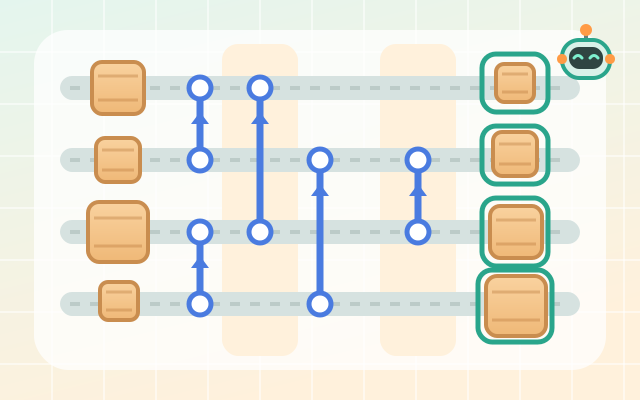
A design puzzle about sorting algorithms, built around sorting networks. The factory has 3 to 6 conveyor belts, and numbered boxes come in from the left. You can fit a swap gate between any two belts: as two boxes pass, it compares them and always sends the smaller one to the upper belt. The gates are fixed and can't look at the boxes first, so a design only counts when it works whatever order the boxes arrive in.
Press "Test all" and the factory sends every possible order through (720 orders for 6 boxes). If any fail, it replays the simplest failing order in slow motion and marks the wrong belts, and gates that never swapped anything turn dashed to show they are spare. The 3-star mark is the fewest gates possible, found by computers trying every option: 5 gates for 4 boxes, 9 for 5 and 12 for 6.
There are 5 chapters and 30 levels: Meet the Gate (smallest and biggest), Sort Everything (inserting, the top two, full sorts), All at Once (gates on different belts work at the same time, with a cap on rounds), Merge Two Runs (combine two sorted runs) and Pick the Places (the median, the top three, the biggest and smallest). An endless Random challenge locks a few gates in place and asks you to finish the job. The hint is worked out on the spot and shows where the next gate should go, or which gate rules out 3 stars.
How to play
- Tap "Start designing" to carry on from the first level you haven't cleared, or pick a chapter from "Levels". The first time you open a chapter, an engineer note explains the idea with a small picture, and "Engineer notes" on the title screen lets you read them again.
- The task bar at the top gives the goal and the rule. The boxes on the right show where boxes must end up: a box with a number needs the box of that rank (1 is the smallest), and a box with only a dot can take anything. Belts grouped by a purple bracket on the left get their boxes already sorted, small to big.
- Tap two belts to fit a gate; the small arrow on a gate shows that the smaller box goes up. "Try one" lets you watch a random set of boxes go through, and when you are ready, press "Test all". A failed test costs nothing: watch the failing order, change your gates and test again.
- Every gate counts, and the task bar shows your gate count and rounds. Chapter 3 and some later levels cap the rounds: gates that don't share a belt can go in the same round. Matching the fewest gates (within the round cap) earns 3 stars, 1–2 more gates 2 stars, and more than that 1 star; a hint caps the level at 2 stars. Clearing 3 levels of a chapter opens the next one.
Controls
- Phone / tablet: tap one belt on the left, then another, to fit a swap gate between them (or press on one belt and release on the other); tap the same belt again to cancel. Tap a fitted gate to remove it; grey gates with a padlock came with the level. The buttons below are Undo, Clear, "Try one" to watch one set of boxes go through, and "Test all" to send every order. Tap the factory during an animation to finish it at once. The light bulb at the top right gives a hint.
- Mouse: the same as touch, click belts to fit a gate and click a gate to remove it. With many gates, the gate area scrolls sideways.
- Keyboard: ↑ ↓ choose a belt, Enter or Space picks it (two picks fit a gate); ← → choose a fitted gate, Delete or Enter removes it; U or Backspace undo, T test all, P try one, H hint, M mute, Esc cancels a pick or goes back.
For parents
- Made mainly for teens, and 9–12-year-olds can start with Chapter 1. It covers the computing topics of sorting algorithms and efficiency: compare-and-swap, why every possible input matters (the worst case), lower bounds on comparisons (finding the smallest of n takes at least n − 1), the ideas behind insertion sort and merge sort, rounds of parallel work (depth), the 0-1 principle and the median. Unlike sorting things you can see by hand, a sorting network is a fixed procedure, so players learn to check their ideas against counterexamples.
- A good conversation starter: why multi-core processors and graphics cards can make many comparisons at once, how a tournament can find first and second place in as few matches as possible, and why the median is less thrown off by extreme values than the average. There is no timer. A failed test just replays one example to study, with no penalty and without ending the level. All information is shown with numbers and box sizes, and right and wrong use two different shapes (a ticked circle and a jagged burst), so nothing depends on color.
- No chat, in-app purchases, ads, outbound links or online leaderboards, and no personal details are ever asked for. Stars, seen notes, the number of random puzzles solved and the mute setting are stored only in this device's browser, and the game also works offline.