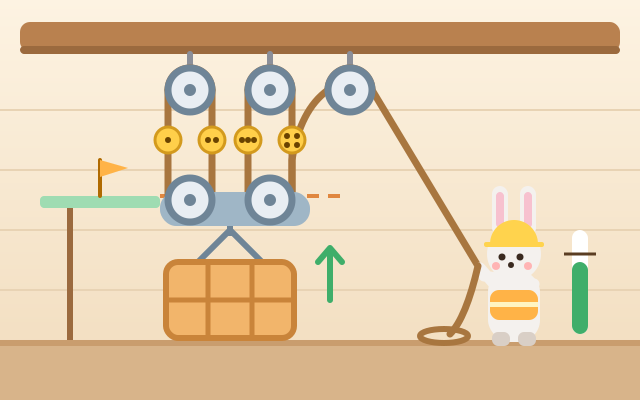
A block-and-tackle physics puzzle. The warehouse ceiling has a few fixed pulleys and hooks, the crate hangs from a block with one to three moving pulleys, and the bunny, raccoon or bear worker beside it is only so strong, with only so much rope. You do the threading yourself: tie the rope end to a ceiling hook or to the hook on the load, tap the pulleys one by one to run the rope around them, then hand it to the worker. Every rope segment that holds the load up gets a number, and that number is how many times easier the pull becomes.
Then swipe down on the picture again and again (or hold the button) to haul in the rope, and the load rises in true proportion: with 4 segments holding it, 4 m of rope lifts it just 1 m. If the worker isn't strong enough, they strain and nothing moves; if the rope is too short, the load stops in mid-air. The game tells you how far off you were, and "Re-thread" lets you change the setup.
There are 5 chapters and 30 levels: Fixed pulley (changing direction), Moving pulley (half the effort), Block and tackle (the segment count is the multiplier, and tying to the load makes it odd), Not enough rope (less force means more rope, so you need just enough of both) and Friction (each pulley eats 10% of the pull, so extra turns cost you). Every level is generated by the game and checked by trying every possible threading, so each one can be solved. There is also an endless Random mode.
How to play
- Tap "Start" to carry on from the first level you haven't cleared, or pick a chapter from "Levels". The first time you open a chapter, a pulley note explains its idea, and you can read the notes again from the title screen.
- Read the goal at the top (how heavy the load is and how high it must go), and the numbers below: how hard the worker can pull and how long the rope is.
- Tap a glowing hook to tie the rope end, then tap the pulleys in order, going back and forth between ceiling pulleys and the pulleys on the load. Segments that hold the load get the numbers 1, 2, 3 and so on. Tap the last pulley to take it back, or "Clear" to start over. The rope must come down to the worker from a ceiling pulley.
- Hold "Pull" or swipe down on the picture. Chapters 1 and 2 show the pull and the rope you need straight away; from Chapter 3 on you have to work it out yourself and find out when you pull.
- Get the load up to the shelf to clear the level: the fewest pulleys and success on the first pull earn 3 stars, and using a hint caps it at 2. Clearing 3 levels of a chapter opens the next one. If you're stuck, the light-bulb Hint tells you how many segments you need at least and which hook to start from.
Controls
- Phone / tablet: tap a hook to tie the rope end, tap pulleys in order to run the rope around them, then tap the worker to hand the rope over. Tap the last pulley again to take it back. Once threaded, swipe down on the picture again and again to haul the rope in, or hold "Pull".
- Mouse: the same as touch. Click the hooks, pulleys and worker, then hold "Pull" or drag downward on the picture.
- Keyboard: ←→ pick a hook, pulley or the worker, Enter to thread it; Backspace undo, C clear; hold Space or ↓ to pull; H hint, M mute, Esc back.
For parents
- Made mainly for ages 13 and up, and 9–12-year-olds can start from Chapter 1. It covers the path from primary "simple machines" to secondary-school pulleys, force and work: a fixed pulley changes direction, a moving pulley saves effort, the mechanical advantage equals the number of rope segments holding the load, and saving force costs distance (conservation of work). Rather than memorising formulas, players design the threading, count the segments, predict the pull and the rope needed, and then pull to check.
- The maths follows the ideal pulley model: pull = weight ÷ number of segments, rope to pull = segments × lift height, and Chapter 5 adds friction with each pulley 90% efficient. Forces are shown in kilogram-force. To keep it easy to handle, rope length is estimated with straight lines between pulley centres and the load only moves straight up. A miss is explained gently and one tap lets you re-thread; there is no timer, no lives and no game over, and the screen shows only a warehouse, pulleys and friendly animal workers, with no violence, scary content or gambling.
- No chat, in-app purchases, ads, outbound links or online leaderboards, and no personal details are ever asked for. Stars, seen notes, the number of random challenges solved and the mute setting are stored only in this device's browser, and the game also works offline.