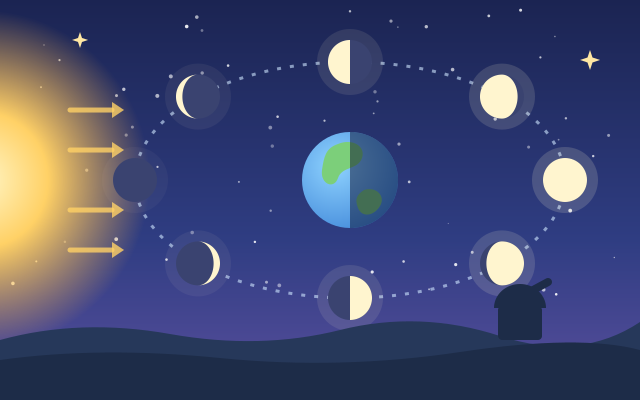
A game about reasoning through the sky with a model. The top half shows sunlight, Earth and the Moon's orbit "seen from above the North Pole"; the bottom half shows the sky you see standing on the ground: the horizon, east–south–west, the colour of the sky, and the Moon's shape and place. The two are linked: move the Moon along its orbit and the Moon in the sky waxes and wanes; change the time and the little person on Earth turns with it, while the Moon and Sun travel across the sky.
Each question has an "observation card", such as "6 pm, high in the south, right half lit", with one item hidden behind a question mark. Work out where the Moon must be on its orbit and what time it is, so the sky matches the card. Other questions go the other way: read the model and pick the right sky from four pictures. A wrong observation is never a fail: the line below says what is different (shape, direction, time, or the Moon being below the horizon), and you can try again straight away.
There are 5 chapters and 30 levels: Moon shapes, when you can see it (moonrise, moonset and direction), days later (about 50 minutes later each day), the Southern Moon (facing north, left and right swap) and eclipses (the Moon's orbit is tilted about 5°, so the node line must point at the Sun). Every question is generated by the game and checked to have exactly one answer, and each chapter has endless random practice. Free observing lets you step day by day and hour by hour to watch the Moon change.
How to play
- Tap "Start observing", or pick a chapter and level from "Levels". The first time you open a chapter, an "Observer notes" card explains its astronomy idea; the notes button at the top shows it again at any time.
- Read the observation card at the top. Tap a spot on the Moon's orbit in the model to place the Moon (there are 8 spots, and the Moon goes round Earth anticlockwise), and use ‹ › below to change the time. The sky below changes as you go. In the model, the half of the Moon facing the Sun is always lit; the pink person on Earth is you, and the green dashed line is your horizon.
- When the sky matches the card, tap "Observe!". If you are right, you learn about when that Moon rises, is highest and sets; if not, you are told what is different, so just keep adjusting. For picture questions, tap one of the four answer cards.
- In the eclipse chapter, the model also shows an orange "node line". Only in a month when it points at the Sun can a full Moon move into Earth's shadow (a lunar eclipse) or a new Moon cover the Sun (a solar eclipse). When it doesn't, tap "Not this month".
- Each level has 4 questions. All right first time with no hint earns 3 stars; 1–2 misses or hints earn 2, more earn 1. Clearing 4 levels of a chapter opens the next.
Controls
- Phone / tablet: tap anywhere on the Moon's orbit in the model and the Moon moves to the nearest spot. Use ‹ › below to change the time by 3 hours, then tap "Observe!". For picture questions, just tap an answer card.
- Mouse: click the orbit, buttons and answer cards, just like tapping.
- Keyboard: ← → move the Moon along its orbit, ↑ ↓ change the time, Enter observe or go on, 1–4 pick an answer, N "Not this month", H hint, M mute, Esc back to the levels. In free observing, ← → step a day, ↑ ↓ an hour, and S switches hemispheres.
For parents
- Designed mainly for ages 13 and up; 9 to 12-year-olds can start with Moon shapes in chapter 1. Why the Moon has phases, why it rises in the east and sets in the west, why it is about 50 minutes later each day and what it takes for an eclipse are all school science topics, and among the most commonly misunderstood ones (for example, "phases are caused by Earth's shadow"). The game has children switch back and forth between a "view from space" model and the sky seen from the ground, practising spatial reasoning instead of memorising rules.
- The astronomy follows real geometry: phase angle, the Moon's hour angle in the sky, the lit side facing the Sun, the left–right flip in the Southern Hemisphere, and the Moon's orbit tilted by about 5° with its nodes. To keep questions clear, the game uses the equinox (sunrise 6:00, sunset 18:00) and draws the sky as one fixed arc; real moonrise times and heights vary with season and latitude, as the developer notes explain. The game reminds players to watch solar eclipses only through proper eclipse glasses. There is no astrology or horoscope content.
- There is no time limit and there are no lives: a wrong answer only explains what is different, and the hint is always available. There is no chat, no in-app purchases, no ads, no outbound links and no online leaderboard, and no personal information is ever asked for. Stars, notes already read and the mute setting stay in this device's browser only, and the game works offline once loaded.