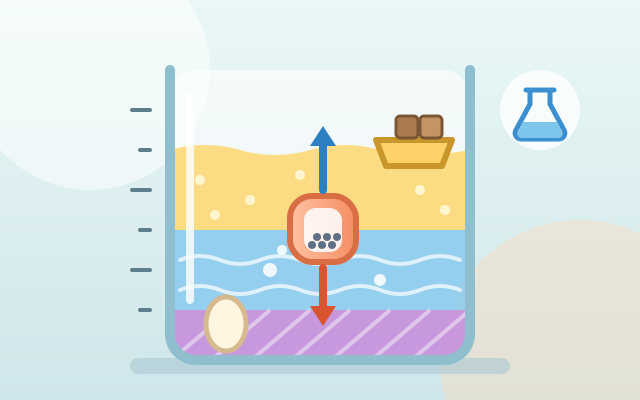
A buoyancy and density lab. In the middle of the screen is a glass tank marked in millilitres, with the object hanging from a crane. You change the object's mass (weights inside a diving capsule, crates on a boat) and the liquid (how much water, how many spoons of salt, how much oil and syrup), then tap "Drop it in!". The game works it out with Archimedes' principle as it goes: buoyancy equals the weight of liquid pushed aside, so the object really sinks, rises, bobs and settles, and the surface rises by the volume pushed aside. When it settles, arrows show its weight and buoyancy, with readings for buoyancy, displaced volume, the scale and the draft.
There are 5 chapters and 25 levels: Sink or Float (average density), The Waterline (one boat sits differently in water, salt water and oil), Displacement (how far a sunken stone or a floating block of wood or ice raises the scale), Salt Water (float an egg by changing only the water) and Layered Liquids (syrup, water and oil stack into three layers; rest the capsule in the green band). Goals include "hover", "a draft of exactly 1.90 cm", "the scale reads exactly 294 mL", "carry as much cargo as possible without sinking" and "float it with as little salt as possible". Every level is generated and checked by the game to have a solution. There is also an endless Random challenge and a Free lab with no goals, where you can pick a capsule, boat, egg, wood, ice or stone.
The idea is to think before you drop: stars depend on how many drops you needed, which rewards working it out from mass, volume and density first. A miss never ends anything. The game explains the gap ("Draft 2.31 cm, goal 1.90 cm: too deep, so the object is too heavy or the liquid too light"), and you lift it out and try again.
How to play
- Tap "Start" to carry on from the first level you haven't cleared, or pick a chapter from "Levels". The first time you open a chapter, a lab note explains its idea, and "Lab notes" on the title screen lets you read them again.
- Read the goal at the top. The sliders below are what you can change in this level, each with its value. The small cards list the object's mass, volume and density and each liquid's density, so you can work things out.
- Tap "Drop it in!" and the crane lowers the object into the tank. When it settles, look at the weight and buoyancy arrows, the scale, and the cards for buoyancy, displaced volume and draft.
- Meet the goal to clear the level: success on the first drop earns 3 stars, on the 2nd or 3rd drop 2 stars, later 1 star, and using a hint caps it at 2. If you miss, the game tells you by how much; tap "Lift out", adjust and drop again. Clearing 3 levels of a chapter opens the next one.
- If you're stuck, the light-bulb Hint shows the formula and the numbers for that level. For open-ended play, try "Random" or "Free lab".
Controls
- Phone / tablet: drag a slider or tap − / + to change the weights, cargo, water, salt, oil and syrup, then tap "Drop it in!" and the crane lowers the object into the tank. Once the result is in, "Lift out" lets you adjust again. In the Free lab, tap buttons to pick the object and the capsule size.
- Mouse: the same as touch, drag the sliders or click the buttons.
- Keyboard: ↑↓ pick a row, ←→ change its value, Enter or Space drops in / lifts out / goes to the next level; H hint, M mute, Esc back.
For parents
- Made mainly for ages 13 and up, and 9–12-year-olds can start from Chapter 1. It covers the path from primary "sink or float" to secondary-school density, buoyancy, Archimedes' principle and displacement. Rather than memorising formulas, players predict, drop the object in to test, read the results and correct, practising the hypothesis–experiment–revise loop. Stars depend on the number of drops, which encourages thinking before trying.
- The physics is real: buoyancy = liquid density × displaced volume, liquids layer by density, and the surface rises by the displaced volume, so the results match the textbook. To keep it easy to handle, every object is simplified to an upright block, each spoon of salt adds a fixed 0.01 g/cm³, and forces are shown in gram-force. A miss is explained gently; there is no timer, no lives and no game over, and the screen shows only lab equipment, with no violence, scary content or gambling. It pairs nicely with trying the egg-in-salt-water experiment at home with a glass of water.
- No chat, in-app purchases, ads, outbound links or online leaderboards, and no personal details are ever asked for. Stars, seen notes, the number of random challenges solved and the mute setting are stored only in this device's browser, and the game also works offline.