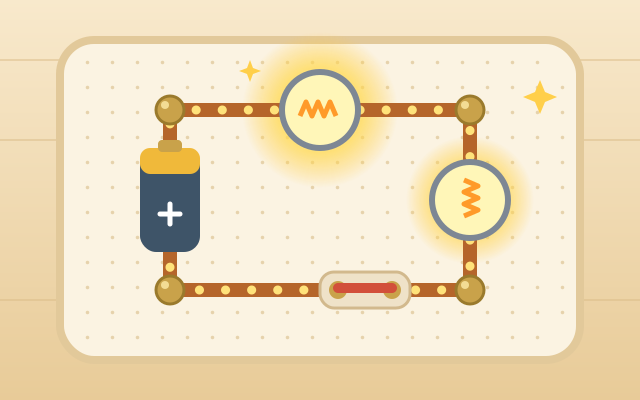
A hands-on circuit game. The screen is a board with brass pegs, and you place 1.5-volt cells, wires, 10-ohm bulbs and switches between pairs of pegs to build your own circuits. The game solves the circuit for real (nodal analysis and Ohm's law) every time you change it, so each bulb glows according to its actual power, with a brightness tag such as "×1/4" beside it, and gold dots flow along the wires, faster where there is more current.
There are 4 chapters and 21 levels: Close the Loop, Series, Parallel and Mixed Circuits. Goals include "light up A", "A and B both at exactly ×1", "the switch controls only B" and "A brighter than B brighter than C", and every level has been checked by the game to have a solution. There is also an endless Random challenge, where the game builds a circuit and you reproduce its set of brightness levels, and a Free lab with no goals and plenty of parts.
Real circuit behaviour shows up: two cells wired against each other cancel out, bulbs in series get dimmer, too much voltage breaks a filament, and a wire straight across a cell makes a short circuit. None of these is a fail. The game gently explains what happened; a tap with the Hand fits a new bulb, and removing the shortcut wire puts things right.
How to play
- Tap "Play" to start from level 1, or pick a chapter from "Levels". The first time you open a chapter, a "Lab notes" card explains its idea; the book button has a guide to every part.
- Read the "Goals" list at the top. Pick a tool at the bottom, then tap between two pegs on the board to place a part. The number on each tool is how many are left, and some parts are fixed to the board.
- Current has to leave the + end of a cell (the gold end), go all the way round and come back to the − end before a bulb will light. Tap a part with the Hand to see its voltage, current and brightness; tap a switch to turn it on or off, or a cell to flip it.
- In levels with a switch, the goals are split into "on" and "off" cases. The game checks both cases for you, so you don't need to keep flipping the switch.
- When every goal has a tick, the level is done. If you are stuck, "Hint" places, removes or flips one part to match a reference solution and circles the spot. No hints earns 3 stars, one hint 2, more hints 1. Clearing 3 levels of a chapter opens the next.
Controls
- Phone / tablet: pick a tool at the bottom (wire, bulb, cell, switch), then tap between two pegs on the board to place it; tap it again with the same tool to take it away. The Hand turns switches on and off, flips a cell's + and − ends, replaces a burnt-out bulb, and shows the voltage and current of any part you tap. Remove sends a part back to the tray.
- Mouse: the same as touch, click a tool and then a spot.
- Keyboard: arrow keys move between spots, Enter or Space places, keys 1–6 pick a tool; Z undo, H hint, M mute, Esc back to the menu.
For parents
- Made mainly for ages 13 and up, and 9–12-year-olds can start from Chapter 1. It covers the school science path from "make the bulb light" to series and parallel circuits, voltage, current and Ohm's law. Rather than memorising formulas, players build circuits, read the meters, compare brightness and reason back from what they see, practising observation, prediction and testing.
- The circuits are solved with real physics and brightness follows power, so results such as "two bulbs in series each get a quarter of the brightness" match the textbook. A short circuit or a burnt-out bulb is explained gently and never ends the game; there is no timer and there are no lives, and a hint changes just one part. Everything on screen is circuit parts, with no violence, scary content or gambling. Worth saying to children: the game's cells are only 1.5 volts, and real mains sockets are very dangerous and never something to experiment with.
- No chat, in-app purchases, ads, outbound links or online leaderboards, and no personal details are ever asked for. Stars, seen notes, the free-lab circuit and the mute setting are stored only in this device's browser, and the game also works offline.