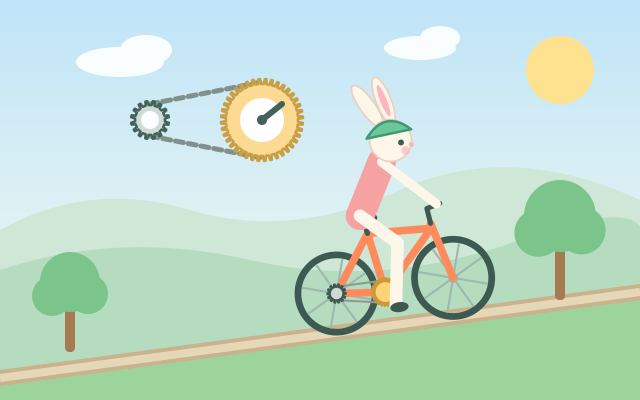
A physics game about gears. The bunny rider pedals hard on their own, and your job is to shift as the road rises and falls: easier before a climb, harder on flats and descents, so the legs keep turning at 65–95 turns a minute (the green band). Below the road, a chainring, rear cogs and chain drawn to their real tooth counts turn with the pedals and the wheel, and the screen shows the gear ratio as you ride (for example 42 ÷ 16 = 2.63, so one pedal turn spins the wheel 2.63 times), along with cadence, speed, push and slope.
It runs on a real physics model: speed = cadence × gear ratio × wheel circumference. The legs push less the faster they spin, and the push on the road = pedal torque × rear teeth ÷ front teeth ÷ wheel radius, minus the slope, rolling resistance and air drag. So in too hard a gear the bunny can't turn the pedals on a steep hill and has to get off and walk, and in too easy a gear the legs spin out and the bike can't pick up speed.
There are 5 chapters and 25 levels: 3 speeds, 6 speeds, front and rear gears together (big and small rings), headwinds and tailwinds, and a cargo trailer. The first time you enter a chapter, a gear note explains the idea. Courses are generated, and the star times come from a simulated rider who always picks the strongest gear. There is also an endless Random course mode.
How to play
- Tap "Ride" to carry on from the first level you haven't cleared, or pick a chapter from "Levels". The card before each ride shows the course length, the times for 1–3 stars and which gears you have, and you can set your starting gear before you go.
- Tap "Go!" and the bunny pedals on its own. Watch the cadence bar: the bike is fastest with the needle in the middle green band. If it drifts left (grinding), tap "Easier"; if it drifts right (spinning), tap "Harder". The course profile at the top and the slope label at the bottom left show climbs before you reach them.
- From Chapter 3 you have two front rings: "Small" for climbs, "Big" for flats and descents, then fine-tune with the rear. Chapter 4 adds headwinds (like an invisible hill) and tailwinds, and Chapter 5 adds the weight of a trailer.
- If the gear is too hard to turn, the bunny gets off and walks, then rides again once you shift easy enough. Reach the finish to clear the level; your time sets the stars. With the light-bulb hint on, the best button glows, but that ride is capped at 2 stars. Clearing 3 levels of a chapter opens the next one.
Controls
- Phone / tablet: tap "Easier" or "Harder" at the bottom to change the rear cog, and from Chapter 3 "Small" or "Big" to change the front ring. The shift happens the moment your finger touches the button. Tap "Go!" to start, and pause any time during the ride.
- Mouse: click the buttons to shift, the same as touch.
- Keyboard: ↑ harder, ↓ easier, ← small ring, → big ring; Space or Enter starts, Space or P pauses during the ride; H hint, M mute, Esc back.
For parents
- Made mainly for ages 13 and up, and 9–12-year-olds can start from Chapter 1. It covers secondary-school simple machines, torque, work and power: how a gear ratio trades force for speed, why climbs need easy gears, and what headwinds and heavy loads change. Rather than memorising formulas, players decide while riding by watching the cadence and push readings, and the results screen explains what could go better ("Shifting easier before a climb is faster").
- The physics is real: it uses a real wheel size, tooth counts, rolling resistance and air drag, and models the rider with the common "torque falls linearly with pedal speed" curve, so the best cadence and the gears needed for a climb match a real bike. To make slopes easy to read, the hills are drawn taller than they are. Nothing ends in failure: if the gear is too hard the bunny simply walks for a while, and you can ride again with one tap. There is no violence, scary content or gambling. The bunny wears a helmet, and so should every real rider.
- No chat, in-app purchases, ads, outbound links or online leaderboards, and no personal details are ever asked for. Stars, best times, seen notes, the number of random courses finished and the mute setting are stored only in this device's browser, and the game also works offline.