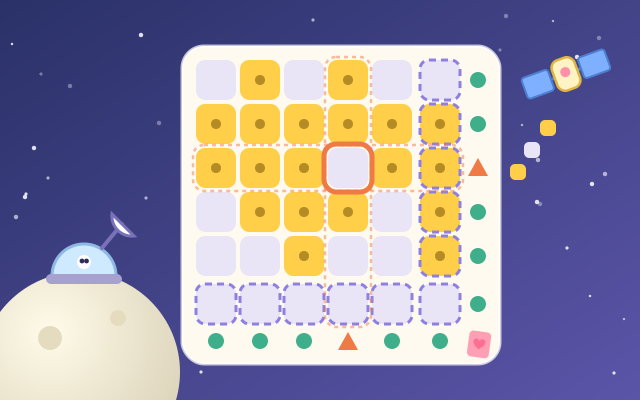
A puzzle game about data compression. The post office has to send a message of symbols (stars, hearts, leaves, drops, moons, clouds, notes and flowers) as 0s and 1s. Giving every symbol a code of the same length is a fixed-length code, but some symbols turn up a lot and others rarely, so short codes for common symbols make the whole message shorter. You merge the "count bubbles" of the symbols two at a time, adding their counts, until a single code tree is left; the path of 0 and 1 edges from the root to each symbol is its code.
Every merge adds one bit to the code of every symbol beneath the new node, so the total grows by that node's count, and the game shows it live. Any merge order gives a code that can be decoded, but only merging the two smallest counts each time gives the fewest bits: that is Huffman coding. Cutting levels turn it around: a long run of 0s and 1s with no spaces arrives, and you cut it wherever a symbol's code ends, discovering why a prefix code needs no separators.
There are 5 chapters and 30 levels: First Merges, Cut the Bits, More Symbols, When Does It Shrink? (equal counts don't compress, halves and quarters compress perfectly, and what to do in a tie) and Send and Reply, where you build a tree, send the message and then decode your friend's reply with your own code table. An endless Random message mode is included. Puzzles are generated by the game and checked to have both a better and a worse way to merge, and every message you send becomes a stamp in your album.
How to play
- Tap "Start sending" to carry on from the first level you haven't cleared, or pick a chapter from "Levels". The first time you open a chapter, a post note explains its idea with a small picture, and "Post notes" on the title screen lets you read them again.
- Building the tree: the message to send is at the top, and each bubble below is one symbol with the number of times it appears (×4 means four times). Tap a bubble to pick it, then tap another, and they merge into a node showing the sum, joined by edges marked 0 and 1. A small tree you have merged can be merged again with a bubble or another tree. "Total" grows by the number on each merge, next to the bits a fixed-length code would need. When a single tree is left, each symbol shows its code; tap "Send!".
- Cutting the bits: the code table is at the top and a long run of 0s and 1s is below. Starting from the left, tap the bit where a symbol's code ends to cut right after it, and the symbol appears above that piece. Cutting too early or too late gets a gentle note about what went wrong. In Chapter 5 you build and send first, then decode your friend's reply with your own tree.
- Merge levels: reaching the minimum total earns 3 stars, a little over (within 10%) 2 stars, more than that 1 star. Cutting levels: no wrong cuts earns 3 stars, 1–2 wrong cuts 2 stars. Using a hint caps a level at 2 stars. Undo and restart are always there and there is no timer. Clearing 3 levels of a chapter opens the next one.
Controls
- Phone / tablet: tap a bubble (or a small tree you have already merged) to pick it, then tap another and the two merge into a new node; tap the same one again to cancel. In cutting levels, tap a bit to cut right after it. The bottom-left buttons undo the last step or restart, the light bulb gives a hint, and "Send!" posts the finished tree.
- Mouse: the same as touch, click bubbles to merge, click bits to cut and click the button to send.
- Keyboard: arrow keys move the cursor, Enter or Space selects (or sends once the tree is finished); U undo, R restart, H hint, M mute, Esc back.
For parents
- Made mainly for teens, and 9–12-year-olds can start with the first two chapters. It covers the computing topics of data representation and compression: fixed-length versus variable-length codes, lossless compression, Huffman coding (a greedy algorithm), prefix codes and the idea that uneven data compresses better. Rather than memorising a rule, players merge bubbles, watch the total change live and work out for themselves why merging the two smallest each time is best, and the cutting levels show how a computer reads back a bit stream that has no spaces.
- A good conversation starter: photos sent from a phone, ZIP downloads and streamed music are all compressed, and PNG, JPEG, MP3 and ZIP use Huffman coding or its relatives. There is no timer and no game over. A tree that isn't optimal just earns fewer stars with a suggestion to try again, a wrong cut gently explains whether it was too early or too late, and undo and restart are always available. Symbols never rely on color alone, as each has its own shape, and every bit and every edge is labelled with a 0 or 1.
- No chat, in-app purchases, ads, outbound links or online leaderboards, and no personal details are ever asked for. Stars, seen notes, the number of random messages sent, the running total of bits saved and the mute setting are stored only in this device's browser, and the game also works offline.