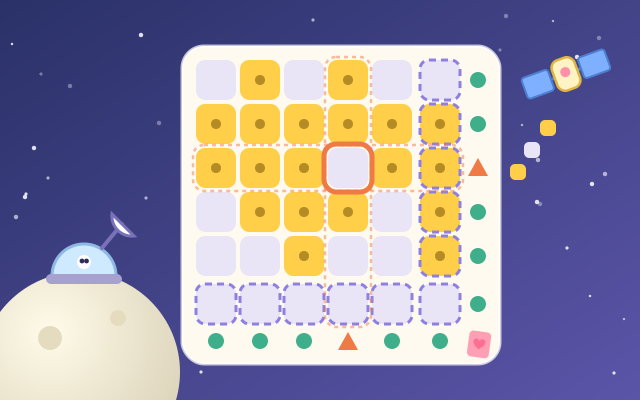
A puzzle game about how computers store data and how they detect and correct errors. Friends at the moon base send 3×3 to 5×5 pixel postcards made of 0s and 1s, but space noise flips bits on the way. You take turns as sender and receiver. When sending, you add "parity bits" to every row and column so each has an even number of 1s. When receiving, you count which row and which column turned odd: the cell where they cross is the flipped bit. Tap it back and the postcard "develops" into its picture.
On the receiving side every tile looks the same apart from its 0 or 1, so you have to reason by counting rather than spot the odd pixel. Later levels bring postcards with no error at all, errors in the parity bits themselves, and two bits flipped at once. With two errors the odd lines cross in more than one place (or only one direction turns odd), so parity can detect the problem but can't fix it, and the right move is "Resend". The final chapter is the Hamming(7,4) code: 4 data bits and 3 parity bits drawn in three overlapping circles, where the set of odd circles points to exactly one wrong bit.
There are 5 chapters and 30 levels: The Even Rule, Find the Flipped Bit, Count It Yourself (counts hidden, with an optional scanner), Two Errors and Hamming Circles, plus an endless Random signal mode. Puzzles are generated by the game and checked to have exactly one correct call, and every fixed postcard goes into your album.
How to play
- Tap "Start" to carry on from the first level you haven't cleared, or pick a chapter from "Levels". The first time you open a chapter, a signal note explains its idea with a small picture, and "Signal notes" on the title screen lets you read them again.
- Sending levels (marked "Sending"): lit cells are 1 and dark cells are 0, and the picture itself can't change. Tap the parity bits in dashed boxes to switch them between 0 and 1 until every row (and, from level 1-3, every column) has an even number of 1s, then tap "Send". The bottom-right corner belongs to both the bottom row and the right-hand column.
- Receiving levels (marked "Receiving"): a circle beside a line means an even number of 1s and a triangle means odd. Find the cell where the odd row and the odd column cross, tap it to flip it back, and tap "Fixed". If every line is even, tap "No error". From Chapter 4, if there are two errors and you can't tell which cells, tap "Resend" and another copy arrives. From Chapter 3 some levels hide the counts, so you count yourself or tap "Scan" to show them.
- Chapter 5, Hamming codes: each row of the postcard is one group of 4 bits placed in three overlapping circles A, B and C, and the mini postcard shows which group you're on. When sending, tap the P bits so all three circles are even. When receiving, look at which circles are odd and flip the bit that sits only inside those circles.
- Finish with no wrong calls, no hint or scan, and no more than 2 taps over the minimum to earn 3 stars. A wrong call or extra taps cost a star, and a hint or scan caps it at 2. A wrong call just gently shows which lines are still odd; undo and restart are always there and there is no timer. Clearing 3 levels of a chapter opens the next one.
Controls
- Phone / tablet: tap a bit to flip it between 0 and 1 (only that one cell changes). When sending, only the parity bits in dashed boxes can change. The buttons below confirm ("Send", or "Fixed" / "No error"), ask for a "Resend" (from Chapter 4) or "Scan" to show how many 1s each line has; the bottom-left buttons undo the last flip or restart, and the light bulb gives a hint.
- Mouse: the same as touch, click a cell to flip it and click a button to confirm.
- Keyboard: arrow keys move the cursor, Space flips a bit, Enter confirms; N resend, S scan, U undo, R restart, H hint, M mute, Esc back.
For parents
- Made mainly for teens, and 9–12-year-olds can start with the first two chapters. It covers the computing topics of data representation (bits) and error detection and correction: parity checks, two-dimensional parity, the difference between detecting and correcting, retransmission and Hamming codes. Rather than memorising rules, players act as sender and receiver, reason from whether the number of 1s is odd or even, and discover that spotting an error and fixing it are two different things.
- A good conversation starter: messages, QR codes and streamed video all meet noise on the way, and computers check and repair them with ideas like these. There is no timer and no game over; a wrong call just gently shows which lines are still odd, and undo and restart are always available. From Chapter 3 the "Scan" button shows the counts at the cost of a star. Odd and even are never shown by color alone: even is a circle and odd is a triangle, and every bit is written as a 0 or 1.
- No chat, in-app purchases, ads, outbound links or online leaderboards, and no personal details are ever asked for. Stars, seen notes, the number of random signals solved and the mute setting are stored only in this device's browser, and the game also works offline.