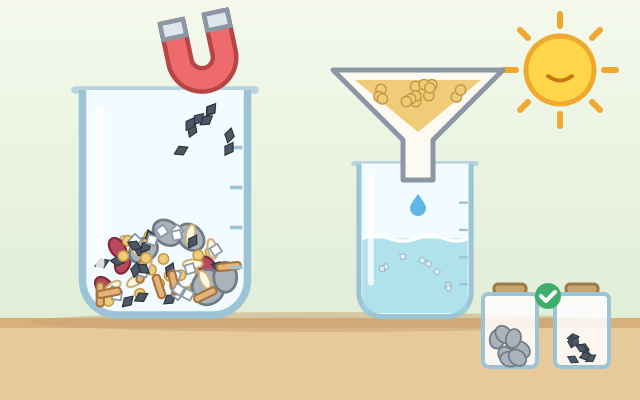
A puzzle game about separating mixtures. On the lab bench is a beaker of everyday materials all mixed together: pebbles, red beans, rice, wood shavings, sand, iron filings, chalk dust, salt, sugar and cooking oil. The goal is to sort every one into its own pure jar. Tap a beaker, then choose a tool: the big and fine sieves sort by grain size, the magnet pulls out iron, adding water and stirring dissolves salt and sugar, the skim net scoops up floating wood shavings, filter paper catches undissolved solids, a separating funnel lets the water out from under the oil, and a sunny windowsill evaporates the water. Each tool splits the beaker in two according to the real properties of what's inside, and every pure beaker flies into its labelled jar at the top.
Solubility works as in real life: 100 mL of water dissolves about 36 g of salt but about 200 g of sugar. With too little water the extra salt stays at the bottom (the solution is saturated), ends up on the filter paper with the sand, and needs another round. There are real limits too: wet mixtures can't be sieved, oil floating on top acts as a lid so the water won't dry, and solids would clog the funnel. A tool that can't work just explains why and doesn't count as a step, so there are no dead ends.
There are 5 chapters and 30 levels: Size and Magnets, Dissolve and Filter, Saturation and Water, Floating and Layers, and a Grand Challenge, plus an endless Random mix mode. Every level is generated by the game, and a search algorithm works out the fewest steps and the least water. Finishing in the fewest steps (and, from Chapter 3, with the least water) earns 3 stars.
How to play
- Tap "Start sorting" to carry on from the first level you haven't cleared, or pick a chapter from "Levels". The first time you open a chapter, a lab note explains its idea and any new tools, and "Lab notes" on the title screen lets you read them again.
- The labelled jars at the top are the materials to sort out, next to your step count and the best possible count. Tap a beaker (it gets an orange frame), then tap a tool below. The labels under each beaker show the grams of each material, how much is dissolved, whether it's saturated and how much water there is.
- For water, choose the amount with − / + and tap "Pour". Remember: 100 mL of water dissolves at most 36 g of salt or 200 g of sugar; with too little water, salt is left at the bottom.
- When a beaker holds just one material and is dry, it flies into its jar; leftover clean water is poured away. Fill every jar to clear the level. The fewest steps earn 3 stars (from Chapter 3, with the least water too), 1–2 extra steps earn 2 stars, and anything else 1 star; using a hint caps it at 2. Clearing 3 levels of a chapter opens the next one.
- If you're stuck, the light-bulb Hint tells you which beaker and tool to use next, and for water it shows how to work out the amount. "Undo" takes back one step and "Restart" starts the level again.
Controls
- Phone / tablet: tap a beaker to select it, then tap a tool below (big sieve, fine sieve, magnet, add water, skim net, filter, oil funnel, sun-dry). For water, choose the amount with − / + (25 mL steps) and tap "Pour". The buttons at the bottom left undo the last step or restart the level.
- Mouse: the same as touch, click a beaker and then a tool.
- Keyboard: ← → pick a beaker, 1–8 use that tool; when adding water, ↑↓ change the amount and Enter pours; U undo, R restart, H hint, M mute, Esc back.
For parents
- Made mainly for ages 9–12, and teens can take on the later Grand Challenge levels. It covers the primary-school topics of solutions (dissolving, saturation, filtering, evaporation, magnets) up to secondary-school separation of mixtures and solubility. Rather than memorising methods, children plan a separation from each material's properties (size, magnetism, solubility, floating), and the "fewest steps" and "least water" goals reward thinking before acting. Chapter 3 asks them to work out just enough water from the solubility.
- Solubilities are rounded room-temperature values (salt about 36 g per 100 mL, sugar about 200 g per 100 mL). To keep it easy to handle, water is poured in 25 mL steps and evaporation happens on a sunny windowsill: there are no flames, heaters or hazardous chemicals. All the materials are everyday kitchen and classroom items. If you try a similar experiment at home, please supervise, don't let anyone eat the materials, and avoid blowing or breathing in iron filings. A tool that can't work is explained gently and doesn't count as a step; there is no timer and no game over, and undo and restart are always available.
- No chat, in-app purchases, ads, outbound links or online leaderboards, and no personal details are ever asked for. Stars, seen notes, the number of random mixes solved and the mute setting are stored only in this device's browser, and the game also works offline.