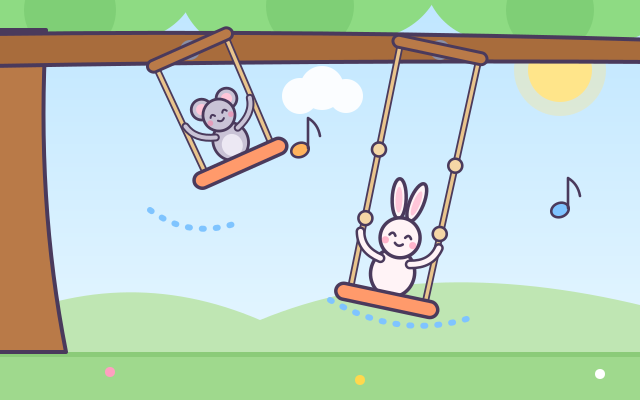
A swing hangs from the branch of a big tree, and its seat can be tied at 4 knots on the rope: tie it high and the rope is short, tie it low and the rope is long. Give it a push and the swing moves by the real pendulum equation. Every time the seat passes the lowest point you hear a "ding" and see a music note, so children can feel the tempo with their ears and eyes: the shortest rope swings back and forth in about one second (ding-ding-ding), the longest takes almost two (ding... ding...). More pushes make the swing go higher, but the ding-ding rhythm stays the same.
Each round has 5 little jobs, with the order, animals and rope lengths changing every time. A sleepy baby wants a slow swing, so make the rope long. A playful friend wants to swing fast, so make it short. To swing together with a friend on the next swing, match the friend's rope, and the two swings move and ding together. A bell hangs in the tree, so push a few times to swing high enough to touch it. Last, "who is faster?": guess whether heavy Big Bear or light Little Mouse (or a small push or a big push) swings faster, then watch them let go together and stay side by side. Each round earns an animal sticker, with 8 animals to collect.
In "Free swing" you can change the rope, switch animals and push as often as you like, and slowly hear how length and speed go together.
How to play
- Tap "Play!". The speech box at the top says what the job is (tap it to hear it again), and the 5 stars show how far along the round you are.
- Change the rope: tap a knot button below. The lower the seat (the longer the rope), the slower it swings; the higher the seat (the shorter the rope), the faster. You can also tap a knot or dotted seat in the picture, or drag the seat up or down. The swing stops while the rope is re-tied.
- Push: tap the pink hand button or anywhere else in the picture. Any moment works, and every push swings higher. Listen to how long it is between each "ding".
- "Who is faster?": tap the card you think. Any guess is fine; both swings are let go together to show you the answer.
- The wrong rope is fine too: the animal tells you whether it should be longer or shorter, and the right knot glows. If nothing happens for a while, the button to press glows. Finishing all 5 jobs earns an animal sticker.
Controls
- Phone / tablet: tap one of the 4 knot buttons below (pictures of a short to a long swing) to change the rope, and tap the pink hand "Push" button to push. You can also use the picture itself: tap a knot or a dotted seat to change the rope, drag the seat up or down, or tap anywhere else to push.
- In the "who is faster?" job, tap one of the 3 picture cards (Big Bear / just as fast / Little Mouse, or the low swing / just as fast / the high swing).
- The buttons are big (at least 64 px) and no timing is needed: a push always helps. Tap the speech box at the top to hear the instructions again (on devices that have a voice).
- Keyboard: ↑ shorter rope, ↓ longer rope, number keys 1–4 pick a knot; Space or Enter pushes; 1–3 answer "who is faster?"; A changes the animal in free swing; Esc returns to the title.
For parents
- Made for ages 3–5. By changing the rope and pushing the swing themselves, children see that a longer rope swings more slowly and a shorter one faster, that more pushes make it swing higher while one back-and-forth still takes about the same time, and that heavy Big Bear and light Little Mouse swing at the same speed on the same rope. These pendulum ideas are how a clock pendulum keeps time, and groundwork for later learning about periods, rhythm and experiments. The swing moves by the real pendulum equation computed live (the period grows with the square root of the rope length and does not depend on weight), not a pre-made animation. Try asking "At the park, which swing is faster?", or tie a small toy to a string together and compare short and long strings.
- There is no losing, no score and no timer. With the wrong rope the animal just says "a bit longer" or "a bit shorter" and the right knot glows; any guess in "who is faster?" gets to see the answer, with extra praise for a right guess. Pushing needs no timing: any moment works. Every button is at least 64 px, and instructions come with icons and can be read aloud by the device's voice with a tap. There is no chat, no in-app purchases, no ads and no outbound links, and no name or personal information is ever asked for.
- Only the animal stickers, the number of rounds played and the sound setting are remembered, in this device's browser (the game still works if saving is blocked). The speaker button switches off both sounds and read-aloud, and the game also works offline.