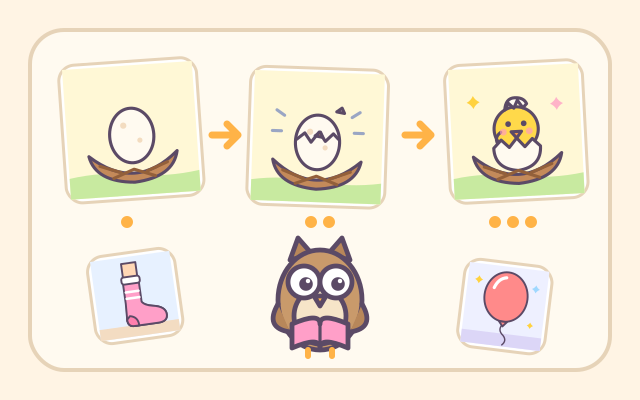
Owl has a blank story book. Each page has 3 or 4 frames in a row, joined by arrows and marked with 1, 2, 3 and 4 dots for "first, next, then, last". The picture cards below are mixed up, and the child thinks about how things happen and puts the cards into the frames in order.
There are 14 little everyday and nature stories: socks before shoes, dough baked into bread, a seed that sprouts and flowers, an egg that cracks and a chick that comes out, blowing up a balloon, eating ice cream, building a snowman, a rainbow after the rain, a sandcastle, picking and washing an apple and eating it down to the core, washing hands with soap and water, lighting and blowing out birthday candles, making a card and mailing it to a friend, and a puppy bath. Every picture is drawn by the game, and there is nothing to measure or count between the cards, so the only clue is what has to happen before something else can.
When every frame is full, the story plays by itself from left to right while Owl says "first… next… last…". If a frame is out of order, the story stops there, a question mark pops up, and Owl says why (for example "Socks first, then the shoes can go on!"). The cards in the wrong place fly back down on their own, the right ones stay, and the child simply tries again. Finished stories go into the story book and can be watched again.
Each story book has 4 pages, and the stories get a little harder as more are finished: first 3 frames with the first one already in place, then 3 empty frames, then 4-frame stories, and later "This is how it ended. What happened before?", where only the last frame is given and the child works backwards. Stories and card order are random every time, and stories not seen yet come first.
How to play
- Tap "Play!". Owl says which story it is. The frames are at the top: the glowing one is where the next card goes, and a frame with a pin already has its card.
- Think "What happens first?" and tap that card at the bottom; it flies into the frame. Keep tapping cards until every frame is full. To change your mind, tap a card in a frame to send it back down, or drag a card straight to the frame you want.
- When the frames are full, the story plays by itself. If it is all in order, confetti flies, the story goes into the story book, and you press "Next page" to go on. The yellow button plays the story again.
- Getting it out of order is fine: the story stops at the frame that is not right, a question mark pops up, Owl says why, and the wrong cards come back on their own. After two tries, the right card and its frame glow together, and the bulb button gives a hint at any time.
- Finish all 4 pages to complete a story book, then choose "New book", open the story book to see the stories you collected, or go back to the title. The book button on the title screen opens the story book too.
Controls
- Phone / tablet: tap a card at the bottom and it flies into the leftmost empty frame (the glowing one); tap a card that is already in a frame to send it back down. Every card is at least 64 px, so taps do not need to be exact, and there is no timing.
- You can also drag a card straight to the frame you want: dropping it on a full frame swaps the two cards, and dragging a card out of a frame back to the bottom takes it back.
- Top buttons: the bulb is a hint (the right card and its frame glow together, or the card to take back first is marked); the speaker turns sound and read-aloud on or off; tap the owl's speech box to hear it again (on devices that have a voice).
- Keyboard: number keys 1–4 pick a card at the bottom, Backspace or Delete takes back the last card you placed, H for a hint, Esc goes back to the title or closes a window.
For parents
- Made for ages 3–5, this game practises time order and cause and effect: what happens first, and what has to happen before something else can. It underpins storytelling, understanding stories and everyday self-care (socks before shoes, soap before rinsing), and leads later to reading comprehension and telling a story with a beginning, middle and end. Unlike ordering things by size or height, nothing can be measured between these cards, so children have to picture how the events unfold.
- Try asking while you play: "Why does the shell have to crack before the chick comes out?" or "What would happen if you put your shoes on first?" Ask your child to tell the whole story with "first… then… last…". You can play it in daily life as well: while baking, at bath time or before going out, ask what comes next, or take a few photos, mix them up and let your child put them back in order. The later "What happened before?" pages ask children to think backwards, which is harder at this age, so it is a nice one to think through together.
- There is no losing, no score and no timer. A story out of order simply stops and says why; right cards stay, wrong ones return on their own, and after two tries (or with the hint button) the right card and frame glow. Buttons and cards are all at least 64 px. Owl's words are read aloud by the device's voice. There is no chat, no in-app purchases, no ads and no outbound links, and no name or personal information is ever asked for.
- Only the number of stories finished, which stories are in the story book and the sound setting are remembered, in this device's browser; the game still works if saving is blocked. The speaker button switches off both sounds and read-aloud, and the game also works offline.