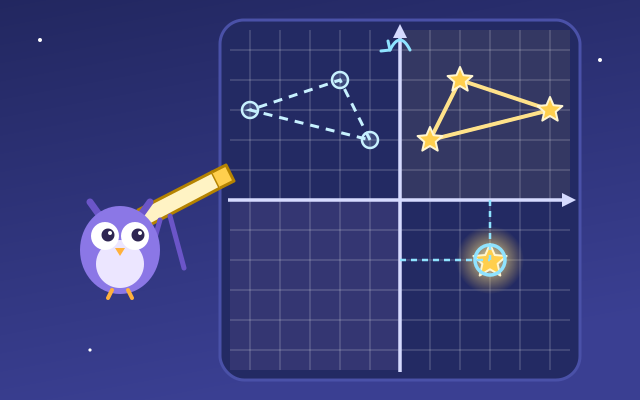
A maths game about the coordinate plane. The owl observatory's night sky is drawn as a grid from −5 to 5: the x-axis goes across, the y-axis goes up, they cross at the origin (0, 0), and they split the sky into quadrants I to IV. Children turn the x and y dials to aim a telescope at a twinkling star, plot the number pairs on a star card to draw constellations, then use coordinate rules such as (x + a, y + b), (−x, y), (x, −y) and (−x, −y) to slide, flip or half-turn a whole constellation.
Constellations don't just jump: after Move! or Transform! they really slide along the rule, flip over like a page, or turn half a circle about the origin, so children can see that changing the sign of x swaps left and right. When a rule misses, an orange dotted shadow shows where it landed and the game says how far off it is or whether the flip is wrong; a wrongly plotted star gets a ring, with a reminder when x and y look swapped.
Five chapters, 30 levels: (1) reading coordinates (x first, four quadrants, points on the axes); (2) plotting constellations; (3) translations, where later levels only say where star A must go and you work out a and b; (4) flips in the y-axis and x-axis and half turns about the origin, then with a slide added; (5) rule detective: predict where one star lands under a rule, or find which of 4 rules moved the constellation (watch for the one that only gets A right). Every puzzle is generated and checked to have exactly one answer, Random challenge never runs out, and 13 original constellations fill the star atlas.
How to play
- Press Start observing, or open Levels and pick a chapter; clearing 2 levels opens the next chapter. The first time you enter a chapter a Grid note explains it; you can read all notes again from Grid notes on the title screen.
- Reading: set x and y so the blue crosshair sits on the twinkling star, then press Observe!. Each level has 4 stars. Plotting: follow the coordinates on the star card, tap where grid lines cross to place stars, then press Connect!; if they are all right, the constellation lights up.
- Translations: set "x +" and "y +"; the rule above updates as you go, for example (x + 3, y − 2). Press Move! to see where the constellation lands; it must cover the dashed A′, B′… Flips: pick a flip, add a slide if needed, and press Transform!.
- Rule detective: in Predict puzzles, work out where the marked star goes under the rule, put the crosshair there and press Predict!. In find-the-rule puzzles, pick one of 4 rule cards; a wrong card shows its result as a faint shadow.
- Stars: no mistakes and no hints earns 3; 1–2 mistakes or a hint earns 2; more earns 1, and you always finish. There is no timer. The light bulb hint sets one number, places one star, or removes one wrong choice.
Controls
- Phone / tablet: tap ‹ › on the x and y dials to change the numbers. In reading, plotting and predicting puzzles you can also tap where grid lines cross in the sky (it snaps to the nearest point). While plotting, tap a placed star again to remove it.
- In flip puzzles, pick No flip, Flip ↔, Flip ↕ or Half turn; in find-the-rule puzzles, tap one of the 4 rule cards. The big button below is Observe!, Connect!, Move!, Transform! or Predict!, and the round arrow restarts the puzzle; the light bulb at the top right is a hint and the speaker turns sound on or off.
- Mouse: click just like tapping; there is no dragging.
- Keyboard: ← → set x (or how much to add to x), ↑ ↓ set y, Enter confirm, Space place or remove a star, 1–4 pick a flip or a rule card, H hint, R restart, M sound, Esc back; after a level, Enter goes to the next one.
For parents
- Designed for ages 9–12, matching upper-primary to early-secondary work on the coordinate plane and on translating and reflecting shapes. It covers ordered pairs with x first, positive and negative coordinates, the signs of the four quadrants (+, +), (−, +), (−, −), (+, −), points on the axes (x or y is 0), the translation rule (x + a, y + b), reflection in the x-axis and the y-axis, a 180° rotation about the origin, and working out a rule from where two points start and end. Feedback targets the most common mix-ups: swapping x and y, getting a sign wrong, and checking only one point.
- All constellations are original made-up pictures (a kite, a sailboat, an umbrella…) and are not real constellations; right ascension and declination appear only in a fact. The dashed target, the solid constellation and the dotted shadow of a miss differ by line style and carry A, B, A′ letters, so nothing depends on colour, and every button is at least 48 pixels.
- No timer: a wrong answer only gets a gentle explanation, every level can be finished, and mistakes only change the stars. No chat, in-app purchases, ads or outbound links, and nothing to type in. Stars, notes already seen, collected constellations, the random-challenge count and the sound setting are stored only in this device's browser; all sounds are synthesised live and can be muted at any time.