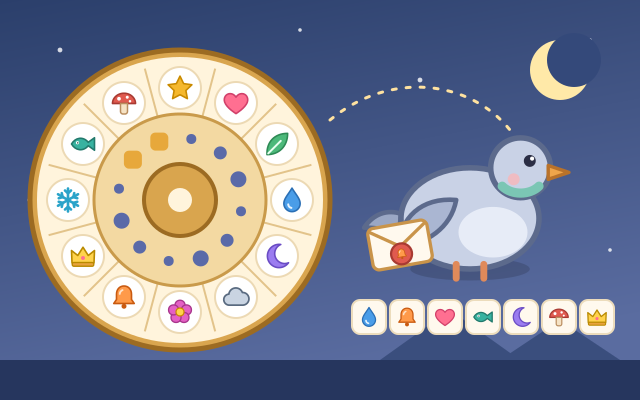
A puzzle game about cryptography. The pigeon post's ledgers could be caught and read, so every letter replaces its plaintext with 12 picture symbols (star, heart, leaf, drop, moon, cloud, flower, bell, crown, snowflake, fish and mushroom). The plaintext only uses 12 symbols, 0–9, + and =, and every line reads "number + number = answer", so no words are needed: when every sum is true, the letter is decoded, and the game plays exactly the same in all three languages.
Chapter 1, Caesar Wheel: the outer ring holds the symbols, the inner ring the plain symbols, and the number of steps you turn it is the key. Decode with a given key, find unknown keys yourself (there are only 12, so you can try them all: a brute-force attack) and encrypt replies with a key. Chapter 2, Substitution: each symbol stands for any plain symbol, so the key is a whole table, worked out from clues such as "every line has one + and one =", "the last digits must add up" and "a three-digit answer starts with 1". Chapter 3, Frequency Analysis: almost nothing is known, and the key table shows how often each symbol appears. Chapter 4, Many Wheels (the Vigenère cipher): 2–3 wheels take turns, so the same plain symbol becomes different symbols; you set the wheels one by one using a known first line or where + and = turn up, and finally work out how many wheels were used.
There are 4 chapters and 24 levels (4 of them are replies to encrypt), plus endless Random letters. Every puzzle is generated by the game and checked by a solver to have exactly one right key, and each decoded letter becomes a stamp in your codebook.
How to play
- Tap "Start decoding" to carry on from the first level you haven't cleared, or pick a chapter from "Levels". The first time you open a chapter, a cipher note explains its idea with a small picture, and the title screen lets you read the notes again.
- The letter is at the top: each square shows a cipher symbol above and the plain symbol you have decoded so far below, with + and = highlighted in yellow. A line whose sum is true gets a ✓, and when every line is true the letter is decoded.
- Wheel levels: tap ◀ ▶ or drag the wheel; the number in the middle is the current key and the letter changes as you turn. Many-wheel levels: the ● ▲ ■ under each square shows which wheel it uses, so choose a wheel above before turning it. With a "known first line", line it up to read 1+1=2 and the keys appear. When the number of wheels is unknown, choose 1, 2 or 3 first.
- Key table levels: tap a symbol, then the plain symbol it stands for. Each plain symbol belongs to only one symbol, so giving it to another moves it over. Grey squares are already known and stay fixed. When the table is full but a sum is false, that line is marked ✗. Encrypt levels: use the key to write the plain text above as symbols, square by square; a wrong tap only brings a gentle note.
- No hints earns 3 stars, and each hint takes one away (at least 1 star remains). In encrypt levels, 1–2 wrong taps give 2 stars and more give 1. Undo and restart are always there and there is no timer. Clearing 3 levels of a chapter opens the next one.
Controls
- Phone / tablet: tap ◀ ▶ beside the wheel, or drag the wheel with a finger to turn the inner ring; on levels with several wheels, first tap ● ▲ ■ above it to choose which one to set. In substitution levels, tap a symbol in the key table (or right on the letter), then tap a digit or + = below; tapping the same plain symbol again clears it. To encrypt a reply, tap the symbol buttons (or the key table squares) one square at a time. Undo and restart are at the bottom left, and the light bulb gives a hint.
- Mouse: the same as touch, click the buttons or drag the wheel.
- Keyboard: ← → turn the wheel, ↑ ↓ switch wheels; in the key table, arrow keys pick a symbol and 0–9, + or = fill it in, Backspace clears; when encrypting, ↑ ↓ pick a symbol and Enter writes it. U undo, R restart, H hint, M mute, Esc back.
For parents
- Made mainly for teens, and 9–12-year-olds can start with the Caesar wheel. It covers the computing topics of security and cryptography: plaintext, ciphertext, encryption, decryption, keys, symmetric encryption, key space and brute force, known-plaintext attacks, frequency analysis and why a polyalphabetic cipher is harder to break. Rather than learning terms by heart, players turn the wheel and fill in the key table, watch the sums turn true line by line, and discover for themselves that too few keys is unsafe and that counts give secrets away.
- A good conversation starter: online banking, messaging apps and the padlock in front of a web address all use encryption far more complex than this, and modern cryptography follows the rule "the method can be public, the key must stay secret", which is also why passwords are never shared. There is no timer and no game over; a wrong tap only brings a gentle explanation, undo and restart are always available, and hints explain their reasons step by step. Symbols are pictures with different shapes, and the wheels are told apart by the shapes ● ▲ ■, never by color alone.
- No chat, in-app purchases, ads, outbound links or online leaderboards, and no personal details are ever asked for. Stars, seen notes, the number of random letters decoded and the mute setting are stored only in this device's browser, and the game also works offline.