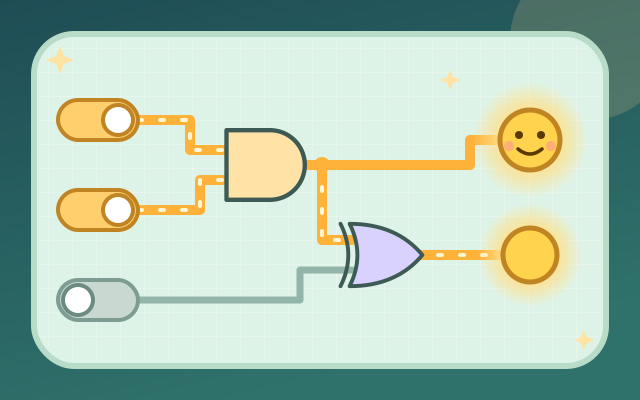
A puzzle game about digital logic. Signals inside a computer are only 1 (power) or 0 (no power), and gates are the smallest deciding parts. The wires and sockets on each circuit board are already laid out, and each level has a truth table saying whether every lamp should be on or off for every combination of switches; your job is to choose the right gate for each empty socket until the whole table matches. When you flip a switch, live wires glow with moving sparks and every lamp shows 0 or 1, so nothing depends on color alone.
Chapter 1 meets NOT, AND, OR and XOR, then experiments with mystery boxes: try every combination, watch the lamp and reason out whether the box hides NAND, NOR or something else. Chapter 2 chains gates into NAND, NOR, an equality detector and a three-way majority vote. Chapter 3 brings in binary: the lamps are labelled with place values 1, 2 and 4, and you build a half adder, an add-one machine and a subtractor that borrows, and see why 1+1=10. Chapter 4 is the full adder, which also adds the carry from the place before, including one level with no OR allowed. Chapter 5 links full adders into a 2-bit adder (3+3=6 must come out right), then builds an equality comparator, a greater/equal/less comparator and a selector (multiplexer).
There are 5 chapters and 30 levels (4 of them mystery boxes), plus endless Random circuits made by the game. Any wiring that matches the whole truth table counts, even if it differs from the reference answer.
How to play
- Tap "Start building" to carry on from the first level you haven't cleared, or pick a chapter from "Levels". The first time you open a chapter, a workshop note explains its idea with a small picture; the title screen lets you read the notes again, and the gate guide lists every gate's rule and truth table.
- Tap a dashed socket and choose a gate from the menu; each gate comes with a one-line rule. Tap the switches on the left to flip 0/1, and the lamps, the wires and the "Yours" column of the table show the result for the current row straight away. Experiment as much as you like; it never costs anything.
- When you are confident, press "Test all": the circuit runs through every combination row by row, right rows get a ✓ and wrong ones a ✗, and the switches stop on the first wrong row so you can find the bad signal. On mystery box levels the Goal column starts as question marks and fills in as you try each combination; tapping a box records your guess for the gate inside.
- No failed tests and no hints earn 3 stars, and each failed test or hint takes one away (at least 1 star remains). There is no timer and you can restart any time. Clearing 3 levels of a chapter opens the next one.
Controls
- Phone / tablet: tap a dashed socket on the circuit board and pick a gate from the menu (tap an installed gate to swap or remove it; grey gates with a lock are already installed and stay put). Tap the switches on the left to flip between 0 and 1, and the lamps and wires show the signals straight away. Press "Test all" to send every combination through the circuit; restart is at the bottom left, the light bulb gives a hint and the book opens the gate guide.
- Mouse: the same as touch, click sockets, switches and buttons.
- Keyboard: ← → pick a socket, Enter opens the menu, 1–7 place that gate from the menu, Backspace removes it; Z X C V flip switches 1–4; T test all, H hint, G gate guide, R restart, M mute, Esc back or close.
For parents
- Made mainly for teens, and 9–12-year-olds can start with the single gates of chapter 1. It covers the computing topics of digital logic and data representation: binary and place value, the Boolean operations AND, OR, NOT, XOR, NAND and NOR, truth tables, combinational circuits, half adders, full adders, ripple-carry adders, comparators and multiplexers. Rather than memorizing tables, players flip switches to experiment, reason out rules from how a mystery box behaves, and watch an adder they wired themselves work out 2+3=5.
- A good conversation starter: the processors in phones and computers hold billions of gates like these, and every sum, comparison and decision is built from them; "1+1=10" also explains why computer sizes so often come in 2, 4, 8 and 16. There is no timer and no game over, experimenting with the switches is always free, a failed test only marks the rows that do not match, and hints explain the rule of the gate they reveal. Wires and lamps show signals by thickness, moving sparks and the digits 0/1 as well as color, and every gate is labelled with its name.
- No chat, in-app purchases, ads, outbound links or online leaderboards, and no personal details are ever asked for. Stars, seen notes, the number of random circuits solved and the mute setting are stored only in this device's browser, and the game also works offline.