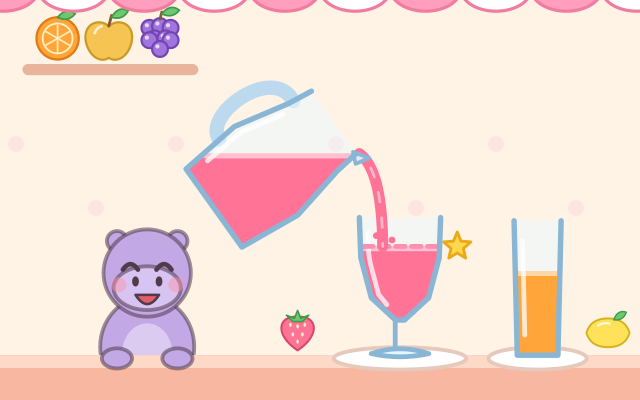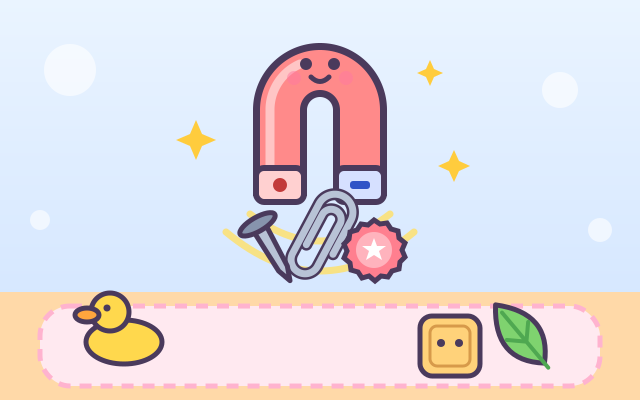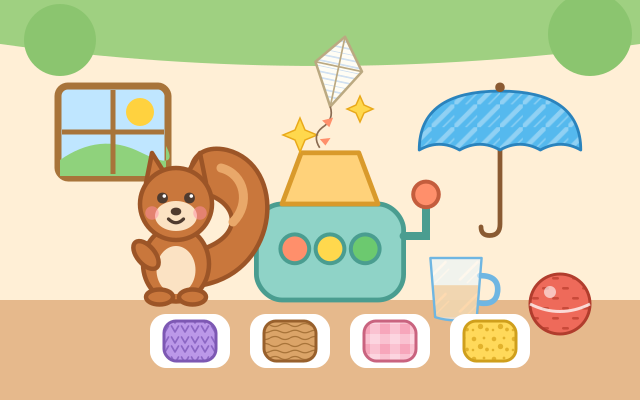
In the squirrel's tree house stands a "swap machine" that can turn a thing into a different material at the press of a button. Animal customers come one at a time to order something: an umbrella for the rain, rain boots for the puddles, a pillow for bedtime, a window for a dark room, a bowl for a goldfish, a towel after a bath, a bouncy ball, a cup for juice, mittens for the snow, a bridge over a stream and a kite for a windy day, 11 things in all.
Each customer offers 3 of the 10 materials (paper, cloth, plastic, sponge, wood, stone, glass, rubber, wool and metal). Your child taps one, the thing turns into it with a "poof", and then it is tried out on screen: a paper umbrella soaks up the rain and droops while a plastic one keeps it off; a stone pillow goes "bonk" while a wool one is soft enough to fall asleep on; a wooden window leaves the room dark while glass lets the sun in; a stone ball lands with a thud while a rubber one bounces high; metal mittens are icy, wooden ones are too stiff to bend, and wool ones are warm.
A material that does not suit the job just shows a funny result, and your child tries another. The right one makes the customer happy, and after 5 customers the things go onto the shelf. Customers, things and material choices are mixed up again for every round, and a round never asks for two things that test the same property. The "Free lab" lets you pair any of the 11 things with any of the 10 materials (110 combinations) to see what a glass kite or a rubber pillow would do.
Every material has its own fixed texture (lines on paper, checks on cloth, grain on wood, holes in sponge, knitted V shapes on wool, rivets on metal), so they can be told apart without relying on color.
How to play
- Tap "Play!". The speech box at the top says what the customer wants (tap it to hear it again), and the 5 stars show how far along the round you are.
- Look at the dashed outline of the thing, think about what it is for, then tap one of the 3 materials at the bottom. The swap machine makes it and tries it out for about 3 seconds.
- If it does not work well (it leaks, is too heavy, too hard, too cold…), the speech box says what happened, a little eye mark appears on that material, and your child can try another. After two materials that do not suit, the speech box names the property to look for (such as "something that soaks up water") and the right material glows.
- The right material makes the customer happy and the next customer comes in. After all 5, you see what was made this round and can play again, open the shelf or go back to the title.
- The "Free lab" has no customers and no questions: change the thing with the arrows and tap any material to see what happens.
Controls
- Phone / tablet: tap one of the 3 big material squares at the bottom (each at least 64 px). The thing turns into that material and is tried out by itself. No dragging, holding or timing.
- Free lab: the two big arrows change the thing, and the row of 10 materials below scrolls sideways; tap one to try it.
- Tap the speech box at the top to hear it again (on devices that have a voice).
- Keyboard: 1–3 pick a material; in the free lab ← → change the thing and 1–9 and 0 pick a material; Enter hears the message again; Esc returns to the title.
For parents
- Made for ages 3–5. By asking "what is this thing for?", children meet the properties of materials: waterproof (umbrella, boots), absorbent (towel), soft or hard (pillow), see-through (window, fish bowl), bouncy (ball), leak-proof (cup, bowl), warm (mittens), strong (bridge), and light or heavy (kite, umbrella, cup). They find that one material can be great for one job and poor for another: glass makes a fine window but icy mittens, and sponge makes a good towel but a leaky cup. This is groundwork for later learning about properties of materials and choosing materials for a purpose.
- Rounds only use materials whose result is clear in everyday life. Combinations that people sometimes really do make, such as paper cups, plastic windows or rope bridges, are never offered as a wrong choice; they appear only in the free lab. Try asking "What is our umbrella made of?" or "Why aren't towels made of plastic?", or drip a little water onto paper, cloth, a plastic bag and a sponge together to see which ones soak it up.
- There is no losing, no score and no timer. A material that does not suit the job only shows a funny result and "try another", and a hint appears only after two such tries. Buttons and material squares are at least 64 px and need only a tap. The speech box can be read aloud by the device's voice with a tap. There is no chat, no in-app purchases, no ads and no outbound links, and no name or personal information is ever asked for.
- Only the shelf (which things were made, and from which materials), the number of rounds played and the sound setting are remembered, in this device's browser; the game still works if saving is blocked. The speaker button switches off both sounds and read-aloud, and the game also works offline.